Gauges and Engine Monitoring: Boost, AFR, Oil Pressure, and More
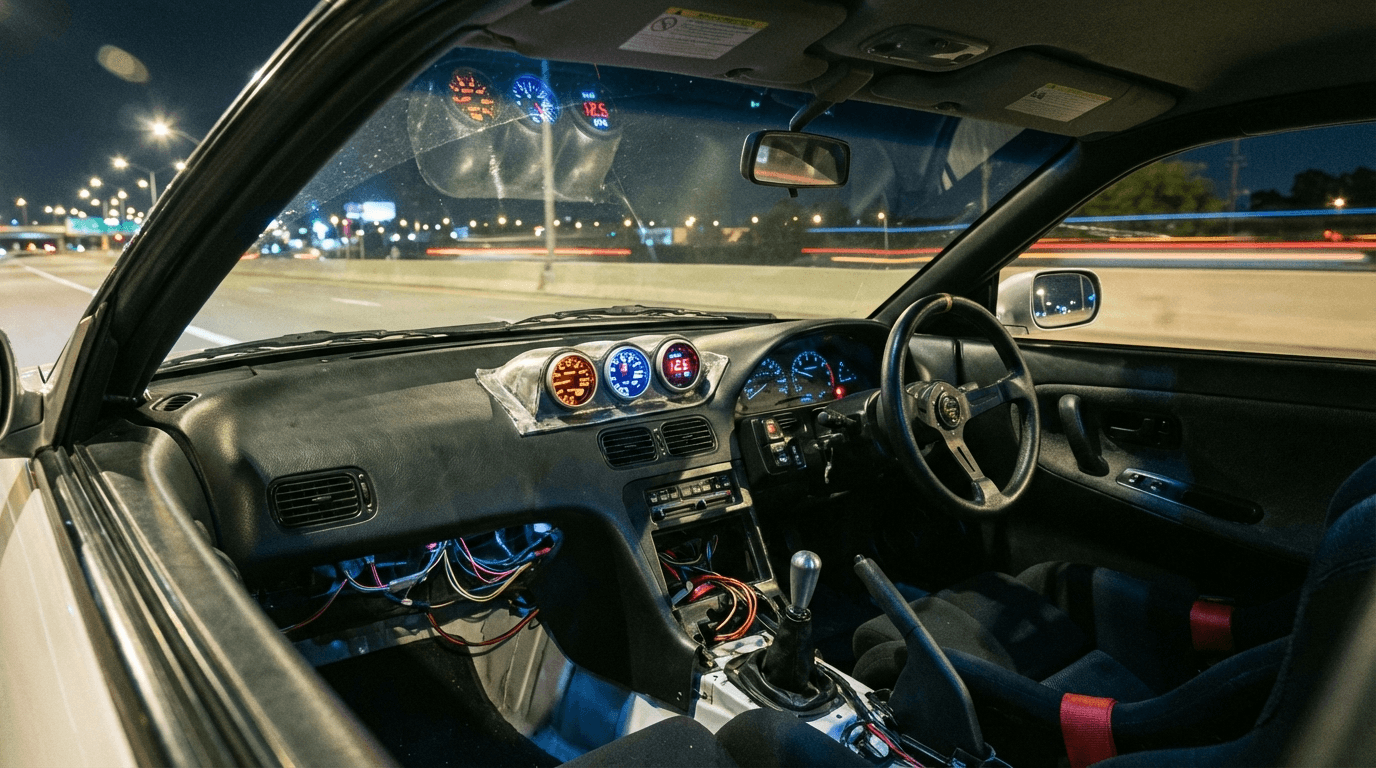
Your car's factory gauges tell you the bare minimum — speed, RPM, fuel level, and a vague engine temperature needle that sits at the same position whether your coolant is 80°C or 105°C. For a stock car, that is fine. For a modified car — especially one with a tune, turbo upgrade, or track use — you need real data to keep your engine safe and your tune dialled in.
Aftermarket gauges give you the precise information that factory instruments hide. This guide covers every gauge you might need, what each one tells you, and which ones are essential versus nice-to-have for your build level.
Why Factory Gauges Are Not Enough
Factory gauges are designed to keep average drivers calm, not to provide accurate data. Common factory gauge tricks:
- Coolant temperature: Most factory temp gauges show "normal" across a 20-30°C range (typically 80-110°C). You will not see the needle move until you are already overheating.
- Oil pressure: Many modern cars have replaced the oil pressure gauge with a simple warning light that only activates when pressure is critically low — by then, damage may already be occurring.
- No boost gauge: Most factory turbo cars do not show boost pressure at all, or show it in a simplified bar graph in the infotainment system.
For a modified engine running higher boost, more aggressive timing, or track duty, you need actual numbers, not reassuring needles.
Essential Gauges for Modified Cars
Boost Gauge (Turbo Cars — Essential)
If you have a turbocharged car and you are running any boost modification — even just a Stage 1 tune — a boost gauge is the first gauge you should install.
What it tells you:
- Actual boost pressure in real-time (typically in psi, bar, or kPa)
- Vacuum level during deceleration
- Whether your turbo is hitting the target boost from your tune/boost controller
- If boost is dropping off (potential boost leak or wastegate issue)
What to look for:
- Mechanical or electronic (electronic is more accurate and offers peak recall)
- Range: -30 inHg to 30+ psi for most builds
- Peak recall: remembers the highest boost reading
Price: RM 100 - RM 500 (mechanical), RM 200 - RM 800 (electronic)
Wideband Air-Fuel Ratio (AFR) Gauge — Essential for Tuned Cars
A wideband AFR gauge measures the ratio of air to fuel in your exhaust. This is critical for any tuned car because it tells you whether your engine is running rich (too much fuel), lean (too little fuel), or at the target ratio.
What it tells you:
- Real-time air-fuel ratio (displayed as Lambda or AFR)
- Stoichiometric (ideal for cruise): 14.7:1 AFR / Lambda 1.0
- Rich under boost (target): 11.5-12.5:1 AFR / Lambda 0.78-0.85
- Dangerously lean: Above 13.0:1 under boost — immediate decel and investigate
Why it matters: Running lean under boost causes detonation, which destroys pistons and bearings. A wideband gauge is your early warning system — if you see the AFR creeping lean under boost, you can back off before damage occurs.
Recommended units:
- AEM UEGO wideband (RM 600 - RM 900) — industry standard
- Innovate MTX-L Plus (RM 500 - RM 800)
- PLX Devices (RM 600 - RM 1,000)
Oil Pressure Gauge — Essential for Track Use and High-Power Builds
Oil pressure is the lifeblood of your engine. A drop in oil pressure means metal-on-metal contact somewhere in the engine — bearings, camshafts, turbo — and catastrophic damage can follow within seconds.
What it tells you:
- Oil pressure at idle (typically 20-40 psi when warm)
- Oil pressure at operating RPM (typically 40-70 psi)
- Pressure drop under sustained cornering (oil starvation)
- Bearing wear over time (gradually declining pressure readings)
When you need one:
- Track use (sustained high-RPM, lateral g-forces)
- Engine making 300+ hp
- Turbo builds (turbo bearings rely on oil pressure)
- Any engine with significant mileage (100,000+ km)
Price: RM 150 - RM 500 (mechanical), RM 300 - RM 800 (electronic)
Oil Temperature Gauge — Recommended for All Modified Cars
As we covered in our engine oil guide, oil temperature critically affects its protective properties. Above 120°C, oil degrades rapidly. Above 130°C, you are causing damage.
What it tells you:
- Whether the oil is warm enough for spirited driving (80°C+ is safe)
- Whether the oil is overheating during hard driving
- Whether you need an oil cooler
Price: RM 100 - RM 400
Recommended but Not Essential Gauges
Exhaust Gas Temperature (EGT) — For Turbo Builds
EGT measures the temperature of exhaust gases at the turbo or exhaust manifold. Useful for:
- Monitoring turbo health (consistently high EGT can indicate turbo inefficiency)
- Tuning verification (lean conditions cause elevated EGT)
- Diesel tuning (EGT is critical for diesel performance tuning)
Normal range: 400-850°C under boost. Above 900°C is concerning. Above 1,000°C requires immediate investigation.
Price: RM 200 - RM 600
Coolant Temperature — For Track Cars
While the factory gauge technically shows coolant temp, it is too vague for track use. An aftermarket coolant temp gauge shows the actual number, so you know exactly when to back off.
Normal range: 80-100°C. Above 105°C, start easing off. Above 110°C, come in.
Fuel Pressure — For High-Power Builds
Monitors fuel delivery pressure. Critical for high-power builds where the fuel system is working near capacity. A drop in fuel pressure under boost means the fuel pump or injectors cannot keep up — and the engine goes lean.
Gauge Types: Mechanical vs Electronic
Mechanical Gauges
The sensor is the gauge — a physical tube or capillary connects the gauge directly to the fluid being measured (oil, boost, fuel).
- Pros: Instant response, no electronics to fail, accurate
- Cons: Requires running a physical line into the cabin (oil line in the cabin is a fire risk in a crash), less feature-rich
- Best for: Boost gauges (air line is safe), budget builds
Electronic Gauges
A sensor at the measurement point sends an electrical signal to a display gauge in the cabin.
- Pros: No fluid lines in cabin (safer), peak recall, warning alarms, data logging, stepper motor for smooth needle movement
- Cons: Slightly more expensive, requires wiring
- Best for: Oil pressure, oil temp, and any gauge where running fluid into the cabin is undesirable
Digital Displays and OBD2 Monitors
Modern alternatives to traditional round gauges:
OBD2 gauge apps — Use a Bluetooth OBD2 dongle and a phone app (Torque, OBD Fusion) to display data from the car's own sensors. Free/cheap but limited to what the factory ECU reports — which may not include everything you need.
Multi-gauge displays — Units like the AEM CD-7 or Defi Advance ZD display multiple parameters on a single screen. Great for keeping the dashboard clean.
Standalone ECU displays — If you are running a standalone ECU (Haltech, Link, MoTeC), the ECU dashboard can display all parameters. No separate gauges needed.
Installation: Where to Mount Gauges
| Location | Pros | Cons |
|---|---|---|
| A-pillar pod | Easy to see, looks purposeful | Can block vision slightly, drilled A-pillar |
| Dashboard top | Good visibility | Can reflect in windscreen |
| Steering column pod | Directly in line of sight | Blocks stalks on some cars |
| Centre console | Clean look | Need to look down |
| Digital display (phone/tablet) | Multiple gauges, customisable | Can look untidy, screen glare |
For most people, a single A-pillar pod holding 2-3 gauges is the cleanest and most functional solution. Have it professionally installed or use a model-specific pod that clips onto the existing A-pillar trim.
Which Gauges Do You Actually Need?
| Build Level | Essential | Recommended | Optional |
|---|---|---|---|
| Stock / Stage 1 tune | Boost gauge (turbo) | Oil temp | — |
| Stage 2 / bolt-ons | Boost, Wideband AFR | Oil temp, oil pressure | EGT |
| Big turbo / high power | Boost, Wideband AFR, Oil pressure | Oil temp, fuel pressure, EGT | Coolant temp |
| Track car | Boost, Oil pressure, Oil temp | Wideband AFR, coolant temp, EGT | Fuel pressure |
| NA performance | Oil pressure | Oil temp | Coolant temp |
FAQ
Can I use my phone as a gauge via OBD2?
Yes, but with limitations. OBD2 reads data from the factory ECU sensors, which update slowly (typically 2-5 times per second) and may not report all parameters you need. A Bluetooth OBD2 adapter with the Torque app is fine for casual monitoring but is not a replacement for proper gauges in a high-power or track build.
Do aftermarket gauges affect my warranty?
Gauges themselves are purely monitoring devices — they do not modify the car. However, a dealer could argue that the presence of gauges indicates other modifications. The gauges themselves should not be grounds for warranty denial.
How accurate are cheap gauges?
Very cheap gauges (under RM 100) can be significantly inaccurate — off by 10-20% or more. For a wideband AFR gauge (where accuracy is critical for engine safety), always buy a quality unit from AEM, Innovate, or PLX. For a boost gauge, even mid-range options (RM 200+) are generally accurate enough.
Should I get a gauge or a data logger?
If you track your car, a data logger (like the AIM Solo 2 or RaceBox) records everything and lets you review after the session. For street use, real-time gauges are more practical since you want to see the data while driving. Many modern gauge setups offer both real-time display and logging.