Engine Oil for Modified Cars: Viscosity, Types, and What You Actually Need
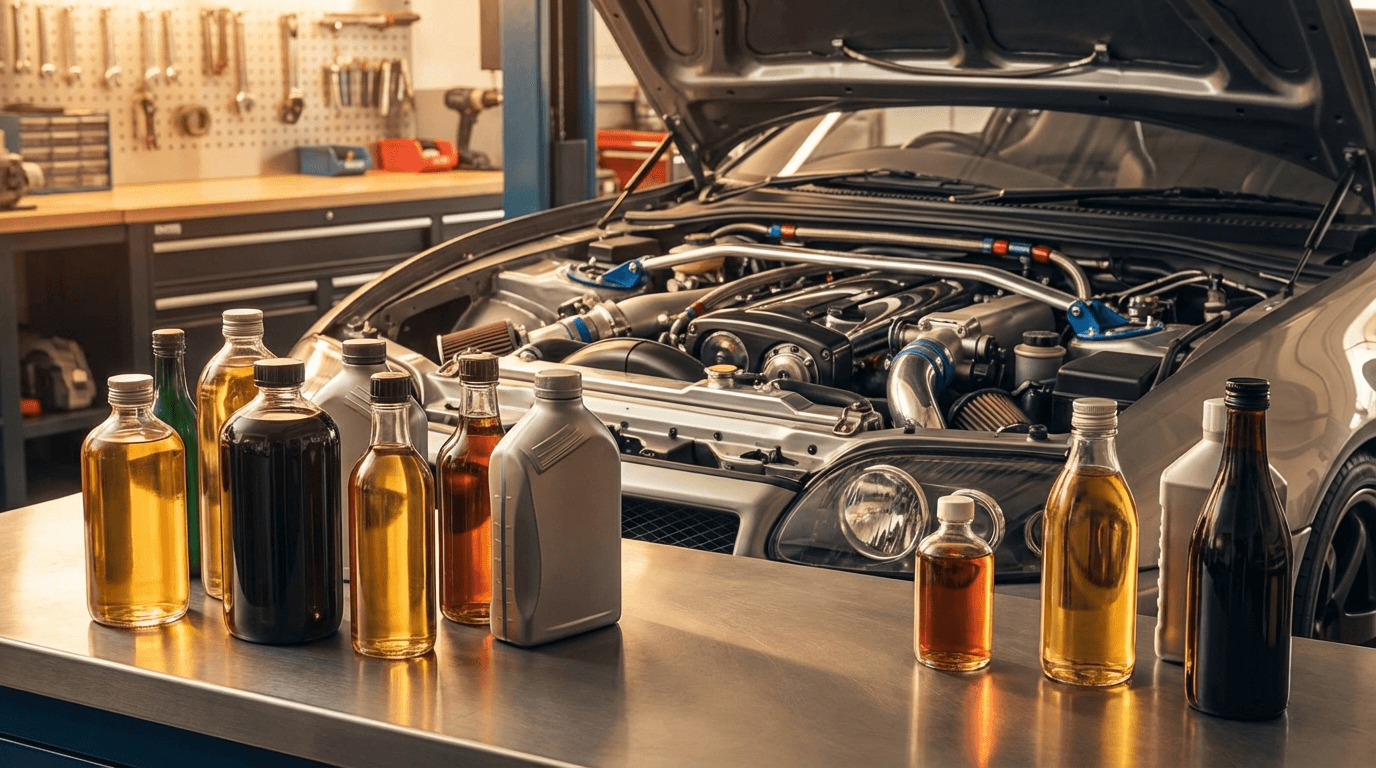
Engine oil is the lifeblood of your engine. It lubricates, cools, cleans, and protects hundreds of moving parts spinning thousands of times per minute. On a stock car, you can mostly follow the manufacturer's recommendation and forget about it. But the moment you modify your engine — especially with a tune, turbo upgrade, or higher-revving setup — your oil requirements change dramatically.
This guide explains everything you need to know about engine oil for modified cars, from viscosity grades to oil types, change intervals, and the specific challenges of running a tuned engine in Malaysia's tropical heat.
How Engine Oil Works
Engine oil serves four critical functions:
Lubrication — The primary job. Oil creates a thin film between metal surfaces (bearings, pistons, camshafts) that prevents metal-to-metal contact. Without this film, your engine would seize within minutes.
Cooling — Oil absorbs heat from hot components (especially the pistons and turbo bearings) and carries it to the oil pan and oil cooler where it dissipates. In a turbocharged engine, the turbo bearing housing can reach 800-1,000°C — oil cooling is what keeps those bearings alive.
Cleaning — Detergent additives in modern oil keep combustion byproducts (carbon, soot, acids) suspended in the oil rather than letting them deposit on engine internals. This is why used oil turns dark — it's doing its job.
Sealing — Oil helps seal the gap between piston rings and cylinder walls, preventing combustion gases from blowing past into the crankcase (blow-by).
Understanding Viscosity Grades
The numbers on your oil bottle (5W-30, 0W-40, 10W-60) describe the oil's viscosity — how thick or thin it is at different temperatures. This is the most important specification when choosing oil.
What the Numbers Mean
Take 5W-30 as an example:
-
5W — The "winter" rating. This number describes how the oil flows at cold temperatures (specifically at -35°C to -10°C depending on the grade). Lower numbers mean the oil flows more easily when cold, which means faster lubrication at startup. 0W flows easier than 5W, which flows easier than 10W.
-
30 — The hot viscosity rating. This describes the oil's thickness at operating temperature (100°C). Higher numbers mean thicker oil at operating temperature, which provides a stronger protective film but creates slightly more resistance (drag).
Viscosity and Modified Cars
This is where it gets important for modified cars:
Higher power = more stress on the oil film. When you increase combustion pressure (through boost, timing, or compression), the forces trying to squeeze oil out from between bearings increase. A thicker oil (higher hot viscosity) resists this squeeze better.
Higher RPM = more shear stress on the oil. As engine speed increases, the oil film is sheared faster. Some oils (especially cheaper ones) can lose viscosity under sustained shear — this is called "shear thinning" and it's dangerous for high-RPM engines.
Higher temperatures = thinner oil. Oil viscosity drops as temperature rises. A tuned engine running harder produces more heat, which thins the oil further. In Malaysia's 35°C+ ambient temperatures, your oil is already starting warmer than in temperate climates.
Viscosity Recommendations by Build Level
| Build Level | Recommended Viscosity | Why |
|---|---|---|
| Stock / Stage 1 tune | Manufacturer spec (usually 5W-30 or 0W-20) | Factory spec is fine for mild tunes |
| Stage 2 / bolt-ons + tune | 5W-40 or 0W-40 | Slightly thicker hot viscosity for increased loads |
| Big turbo / high boost | 5W-40 or 10W-50 | Stronger film for higher cylinder pressures |
| Track use / sustained high RPM | 10W-50 or 10W-60 | Maximum protection at extreme temperatures |
| High-revving NA (9,000+ RPM) | 5W-40 or 10W-50 | Shear resistance at sustained high RPM |
Important: Going too thick is also bad. Excessively thick oil creates more drag, reduces fuel efficiency, and can struggle to flow through small oil passages at startup. Don't put 10W-60 in a stock Myvi.
Types of Engine Oil
Mineral Oil (Conventional)
Mineral oil is refined directly from crude petroleum. It's the cheapest option and has been used in engines for over a century.
- Pros: Cheap, widely available, fine for stock low-stress engines
- Cons: Breaks down faster under heat, lower shear stability, shorter change intervals
- Best for: Stock daily drivers, older engines designed for mineral oil
- Not recommended for: Any tuned, turbocharged, or high-performance engine
Semi-Synthetic (Synthetic Blend)
A mix of mineral and synthetic base oils. Offers some of the benefits of full synthetic at a lower cost.
- Pros: Better than mineral in heat resistance and longevity, reasonably priced
- Cons: Not as durable as full synthetic under extreme conditions
- Best for: Mildly modified daily drivers, budget builds
- Typical price in Malaysia: RM 80 - RM 180 for 4 litres
Full Synthetic
Made from chemically engineered base stocks (PAO or Group IV/V). Synthetic oil has a uniform molecular structure that provides superior performance in every measurable way.
- Pros: Best heat resistance, longest life, best cold-flow, highest shear stability, best protection
- Cons: Most expensive
- Best for: All modified cars, turbocharged engines, track use, Malaysian climate
- Typical price in Malaysia: RM 150 - RM 400 for 4 litres
Ester-Based Synthetic
The premium tier of synthetic oils. Ester base stocks have a natural polarity that makes them "cling" to metal surfaces, providing protection even during cold starts before oil pressure builds.
- Pros: Superior film strength, excellent high-temperature stability, natural metal affinity
- Cons: Expensive, can swell some older rubber seals (modern engines are fine)
- Best for: Track cars, high-performance builds, engines making 400+ hp
- Brands: Motul 300V, Red Line, Royal Purple
- Typical price in Malaysia: RM 300 - RM 600 for 4 litres
Oil Change Intervals for Modified Cars
This is where the manufacturer's 10,000-15,000km recommendation goes out the window.
Why Modified Cars Need Shorter Intervals
A tuned engine puts more stress on oil in every way:
- Higher combustion temperatures break down oil molecules faster
- Higher boost pressure increases fuel dilution (unburnt fuel washing past piston rings into the oil)
- More blow-by on high-boost builds contaminates oil with combustion gases
- Higher RPM increases shear stress and oxidation
Recommended Change Intervals
| Usage Pattern | Interval |
|---|---|
| Stock engine, daily driving | 8,000 - 10,000km (or manufacturer spec) |
| Stage 1 tune, daily driving | 5,000 - 7,000km |
| Stage 2 / bolt-ons, mixed driving | 4,000 - 5,000km |
| Big turbo / high power, daily | 3,000 - 5,000km |
| Track use (any build level) | Every 2-3 track days or 3,000km |
| Dedicated track car | Every 1-2 track days or when oil analysis says so |
In Malaysia's climate, err on the shorter side. Sustained high ambient temperatures accelerate oil degradation. If you're sitting in KL traffic for an hour every day with a tuned turbo engine, your oil is cooking.
Oil Analysis: The Smart Approach
Instead of guessing intervals, you can send used oil samples to a lab (like Blackstone Laboratories) for analysis. They measure:
- Wear metals (iron, aluminium, copper) — tells you how much your engine is wearing
- Contaminants (fuel dilution, coolant) — flags leaks or combustion issues
- Additive depletion — tells you if the oil still has life left
- Viscosity — confirms the oil hasn't broken down
Oil analysis costs about RM 100-150 per sample. For expensive modified engines, it's cheap insurance and it helps you dial in the optimal change interval for your specific car and driving style.
Oil Filters: Don't Cheap Out
Your oil filter is just as important as the oil itself. A poor filter allows contaminants to circulate, accelerating wear.
What to Look For
- Filtration efficiency: Look for filters rated at 99%+ efficiency at 20 microns
- Flow rate: Must not restrict oil flow, especially at high RPM
- Anti-drainback valve: Prevents oil from draining out of the filter when the engine is off (ensures oil pressure on startup)
- Bypass valve: Opens if the filter clogs, allowing unfiltered oil through rather than no oil
Recommended Filter Brands
| Brand | Type | Price Range |
|---|---|---|
| OEM (Bosch, Mann, Mahle) | Paper element | RM 20 - RM 60 |
| K&N HP series | Reusable, high-flow | RM 50 - RM 100 |
| Wix / Ryco | Quality aftermarket | RM 25 - RM 60 |
Change the filter every oil change. Never reuse a filter with fresh oil — the trapped contaminants will immediately contaminate your new oil.
Oil Coolers: When Do You Need One?
If you're pushing your engine hard — especially turbocharged cars in Malaysia — oil temperatures can exceed safe limits. Most engines are designed to operate with oil at 90-110°C. Above 120°C, oil begins to break down rapidly. Above 130°C, you're causing damage.
Signs You Need an Oil Cooler
- Oil temperature consistently above 110°C during spirited driving
- Oil temperature exceeding 120°C on track
- Turbo oil feed temperatures running high
- Oil losing viscosity before your change interval (verified by oil analysis)
Types of Oil Coolers
Thermostatically controlled oil cooler (recommended): Uses a thermostat to bypass the cooler until oil reaches operating temperature. This is important — oil that's too cold is almost as bad as oil that's too hot. Cold oil is too thick to flow properly and doesn't protect well.
Non-thermostatically controlled: Always cooling. Can overcool oil in normal driving, especially with air conditioning on. More suitable for dedicated track cars.
Typical cost: RM 500 - RM 2,000 installed, depending on size and brand.
For more on managing engine temperatures in modified cars, read our complete guide to heat management and cooling.
Malaysia-Specific Considerations
Ambient Temperature Impact
Malaysia's average ambient temperature of 30-35°C means your engine oil starts every drive at a higher baseline temperature than in temperate countries. European oil change intervals (15,000-20,000km) are calculated for average ambient temperatures of 10-20°C. In Malaysia, cutting those intervals by 30-40% is prudent.
Fuel Quality
Malaysian RON 95 has different additive packages than European fuels. Combined with higher ethanol content in some fuel batches, this can increase fuel dilution in the oil — another reason to change more frequently. If you run RON 97 or RON 100, fuel dilution is typically less of an issue.
For more on fuel quality and its impact on modified engines, check out our fuel system upgrades guide.
Traffic and Idling
KL traffic means extended idling, which is terrible for oil. During idle:
- Oil temperature stays in a sub-optimal range
- Combustion efficiency drops, increasing blow-by and fuel contamination
- Oil circulation is at its lowest (oil pump speed = engine speed)
If your daily commute involves heavy traffic, treat your oil change interval as closer to the shorter end of the range.
Common Oil Myths Busted
"You can't switch between synthetic and mineral oil"
This was true decades ago. Modern synthetic oils are fully compatible with mineral oils and you can switch between them freely. The idea that synthetic oil will "leak" from engines designed for mineral oil is largely a myth with modern formulations.
"Darker oil means it needs changing"
Oil turns dark because it's collecting combustion byproducts — that's literally its job. Dark oil doesn't necessarily mean degraded oil. The only reliable way to know if your oil needs changing is oil analysis or following time/mileage intervals.
"Thicker is always better for protection"
As explained above, excessively thick oil creates problems. Modern engines are designed with tight clearances that require specific viscosity ranges. Going from 5W-30 to 10W-60 on a stock engine can actually cause more wear by reducing flow through small passages.
"You should always warm up your engine before driving"
Extended idling to "warm up" is counterproductive. Modern oil reaches working viscosity within 30-60 seconds. The best warm-up is gentle driving for the first 5-10 minutes. Idling warms the oil slowly while providing poor circulation — gentle driving warms it faster with better flow.
How to Choose the Right Oil for Your Build
- Start with the manufacturer's recommendation — this is your baseline
- If you have an ECU tune, step up one hot viscosity grade (e.g., 5W-30 → 5W-40)
- If you're making 300+ hp on a turbo, consider 5W-40 or 10W-50 full synthetic
- If you track the car, use 10W-50 or 10W-60 ester-based oil and change it frequently
- Always use full synthetic on any turbocharged modified engine — the turbo bearing temperatures alone justify it
If your engine is tuned, you should understand what your ECU tune is doing to make informed oil decisions. And remember, regular maintenance of your modified car goes well beyond just oil changes.
Recommended Oil Brands for Modified Cars in Malaysia
| Brand | Popular Grades | Best For | Price (4L) |
|---|---|---|---|
| Motul 8100 X-cess | 5W-40 | Tuned daily drivers | RM 200 - RM 280 |
| Motul 300V | 5W-40, 10W-50 | Track / high-performance | RM 350 - RM 500 |
| Liqui Moly Top Tec | 5W-30, 5W-40 | European cars (BMW, VAG) | RM 200 - RM 300 |
| Castrol Edge | 5W-30, 5W-40 | All-rounder | RM 150 - RM 250 |
| Shell Helix Ultra | 5W-30, 5W-40 | All-rounder | RM 150 - RM 230 |
| Red Line | 5W-40, 10W-50 | High-performance / track | RM 350 - RM 500 |
| Fuchs Silkolene | 5W-40, 10W-60 | Track and motorsport | RM 300 - RM 450 |
| Petronas Syntium | 5W-30, 5W-40 | Budget full synthetic | RM 120 - RM 180 |
FAQ
How often should I change oil on a tuned car?
For a Stage 1 tuned car used daily, every 5,000-7,000km is a good interval. For higher power levels or track use, every 3,000-5,000km. When in doubt, go shorter — oil is cheap, engines are not.
Is 5W-40 good enough for a tuned turbo car in Malaysia?
For most Stage 1 and Stage 2 turbo builds, 5W-40 full synthetic is excellent. The 40-weight hot viscosity provides strong protection without being excessively thick. Only step up to 50 or 60 weight for big turbo builds or dedicated track use.
Can I use motorcycle oil in my car?
Motorcycle oil (especially JASO MA/MA2 rated) has different friction modifier profiles because it also lubricates the clutch. While it won't damage your car engine, it's not optimal. Use oil designed for your car.
Should I use an oil additive?
Quality full synthetic oil already contains a comprehensive additive package. Adding aftermarket additives can actually unbalance the formulation and cause problems. Save your money for more frequent oil changes instead.
Does oil brand matter more than viscosity?
Viscosity matters more. A quality 5W-40 from any reputable brand will protect better than the "best" brand in the wrong viscosity. Get the viscosity right first, then choose a brand within your budget.