Boost Controllers Explained: Manual vs Electronic for Turbocharged Cars
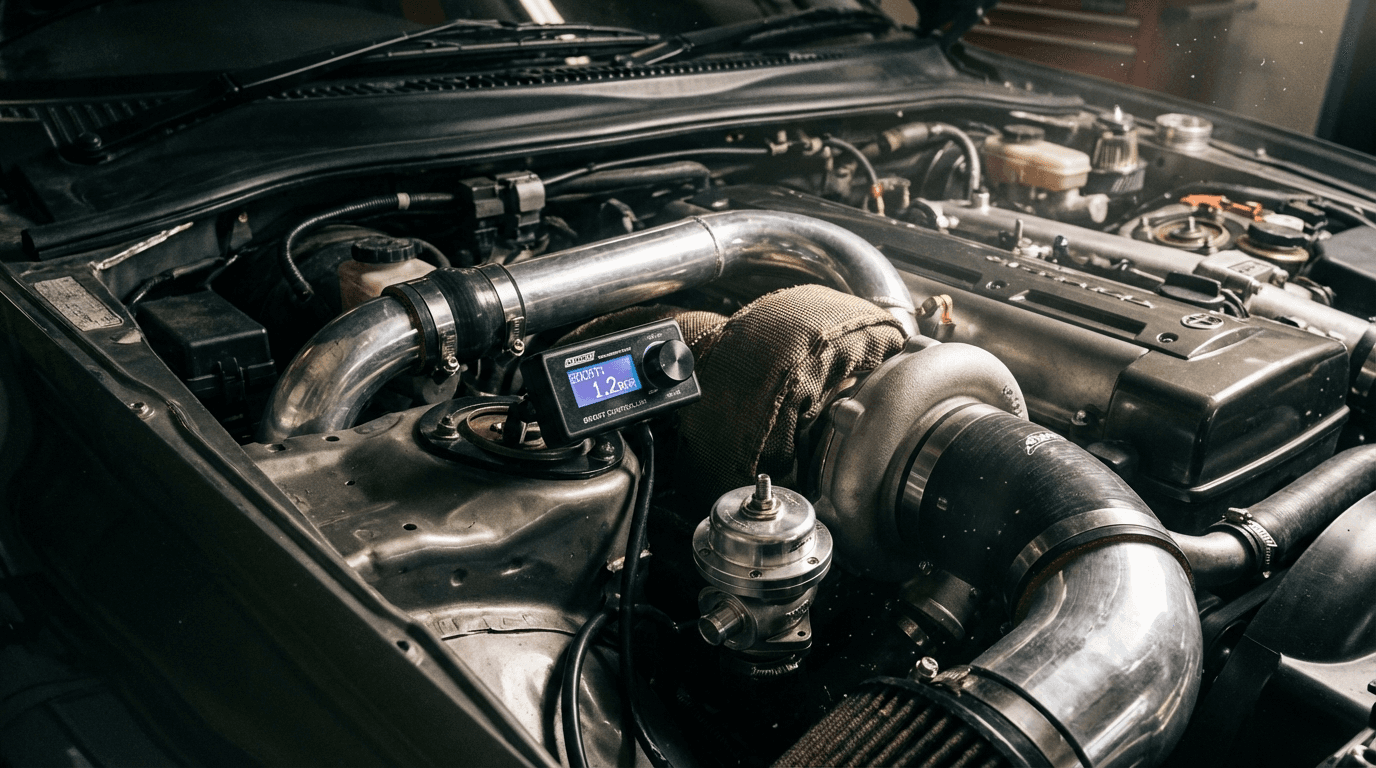
If you own a turbocharged car and want more power, increasing boost pressure is the most direct route. But simply cranking up the boost without understanding how it is controlled is a fast track to a blown engine. A boost controller gives you precise control over how much boost your turbo produces — and understanding how it works is essential for any turbo build.
This guide covers everything from how wastegates work to the differences between manual and electronic boost controllers, common boost problems, and how to safely increase boost on your car.
How Boost Is Controlled: The Wastegate
Before discussing boost controllers, you need to understand the wastegate — the component that actually regulates boost pressure.
What a Wastegate Does
A turbocharger is driven by exhaust gases. As the engine produces more exhaust (higher RPM, more throttle), the turbo spins faster and produces more boost. Without any regulation, the turbo would keep building boost until something breaks — the turbo overspeeds, the engine detonates, or a boost pipe blows off.
The wastegate prevents this by diverting exhaust gases away from the turbine when the target boost pressure is reached. It is essentially a pressure relief valve for your turbo system.
Internal vs External Wastegate
Internal wastegate — Built into the turbo housing. A small flap inside the turbine housing opens to bypass exhaust gases around the turbine wheel. Found on most factory turbo cars. Compact and simple, but limited in flow capacity.
External wastegate — A separate unit mounted on the exhaust manifold before the turbo. Diverts exhaust gases through its own dedicated dump pipe. Used on higher-power builds because they flow more exhaust gas and provide more precise control. External wastegates are rated by size (typically 38mm to 60mm).
How the Wastegate Knows When to Open
The wastegate has a spring inside that holds it closed. A pneumatic actuator (connected to boost pressure via a small hose) pushes against this spring. When boost pressure exceeds the spring pressure, the actuator opens the wastegate.
The factory spring pressure determines your "base" boost level — the boost you get with no controller. On most factory turbo cars, this is around 0.5-0.8 bar (7-12 psi). This is intentionally conservative for reliability.
What a Boost Controller Does
A boost controller manipulates the air signal going to the wastegate actuator. By bleeding off or blocking some of this signal, the controller tricks the wastegate into staying closed longer, which allows the turbo to build more boost before the wastegate opens.
Think of it this way:
- No controller: Wastegate sees actual boost pressure → opens at spring pressure
- With controller: Wastegate sees reduced/delayed boost signal → stays closed longer → more boost builds before it opens
Manual Boost Controllers (MBC)
A manual boost controller is the simplest and cheapest way to increase boost. It is a small mechanical valve that bleeds off a portion of the boost signal going to the wastegate actuator.
How It Works
The MBC is installed in the hose between the boost source (intake manifold or compressor outlet) and the wastegate actuator. A small bleed hole or adjustable valve lets some of the pressure signal escape to atmosphere before it reaches the actuator. Because the actuator sees less pressure than actually exists, the wastegate stays closed longer, and boost rises above the base spring pressure.
You adjust the bleed amount with a small screw — more bleed = more boost.
Pros
- Cheap: RM 50 - RM 300
- Simple: One valve, no electronics, no wiring
- Reliable: No electronics to fail
- Easy to install: 15-30 minutes
Cons
- No precision: You set a single boost level and it stays there regardless of conditions
- Boost creep at high RPM: As exhaust gas volume increases with RPM, the turbo can push past the MBC setting
- Slower boost response: The bleed design inherently slows wastegate response
- Boost spikes: On first spool, the wastegate may not react fast enough, causing a momentary boost spike above target
- No per-gear or per-RPM control: It is all or nothing
When to Use an MBC
An MBC is appropriate for mild boost increases (1-3 psi above stock) on cars that are already tuned for the higher boost level. It is a good budget solution when paired with an ECU tune that accounts for the increased boost.
Electronic Boost Controllers (EBC)
An electronic boost controller replaces the simple bleed valve with a solenoid valve controlled by an electronic unit. This allows precise, dynamic control of boost pressure across the entire RPM range.
How It Works
The EBC uses a solenoid valve that can rapidly open and close (pulsing hundreds of times per second) to precisely regulate how much boost signal reaches the wastegate actuator. A pressure sensor monitors actual boost, and the controller adjusts the solenoid duty cycle to maintain the target boost level.
The electronic brain allows features that a manual controller simply cannot provide.
Features of Modern EBCs
- Target boost setting: Set your exact desired boost level (e.g., 1.2 bar)
- Boost-by-gear: Different boost levels for each gear (lower boost in 1st/2nd for traction, full boost in higher gears)
- Boost-by-RPM: Ramp boost in or out at specific RPM ranges
- Overboost protection: If boost exceeds a safety threshold, the controller closes the solenoid to open the wastegate immediately
- Scramble boost: A temporary higher boost setting activated by a button (for overtaking or spirited driving)
- Data logging: Record boost levels over time for tuning and diagnostics
- Multiple maps: Store different boost profiles and switch between them
Popular Electronic Boost Controllers
| Controller | Features | Price Range |
|---|---|---|
| Turbosmart e-Boost2 | Dual-stage, 6 boost settings, peak/hold display | RM 1,500 - RM 2,500 |
| GReddy Profec | Compact, easy to use, scramble function | RM 1,200 - RM 2,000 |
| AEM Tru-Boost | Gauge-mounted, data logging, boost-by-gear | RM 1,500 - RM 2,500 |
| Cobb Accessport | Combined tune + boost control (car-specific) | RM 2,500 - RM 4,000 |
| Haltech / Link ECU | Full standalone ECU with integrated boost control | RM 3,000 - RM 8,000 |
ECU-Integrated Boost Control
Many modern aftermarket ECU tunes include boost control as part of the tune. The ECU uses the factory boost control solenoid to manage boost levels, eliminating the need for a separate boost controller entirely.
If you are already getting an ECU tune, ask your tuner if boost control is included. This is the most seamless solution because the ECU can coordinate boost levels with fuelling, ignition timing, and safety limits simultaneously.
Common Boost Problems
Boost Creep
Boost creep occurs when the wastegate is fully open but cannot flow enough exhaust gas to prevent boost from rising further. This is most common:
- At high RPM where exhaust gas volume is highest
- With an internal wastegate that has limited flow capacity
- After fitting a larger turbo to a factory manifold with a small wastegate port
Solution: External wastegate with adequate flow, or a larger wastegate port.
Boost Spike
A boost spike is a momentary overshoot above target boost, usually on initial spool. It happens because the wastegate does not react instantly — there is a delay between the signal reaching the actuator and the gate physically opening.
Solution: An EBC with properly tuned proportional-integral-derivative (PID) settings, or stiffer wastegate springs.
Boost Leak
A boost leak occurs when pressurised air escapes from the intake tract before reaching the cylinders. Symptoms include:
- Slow or incomplete boost build
- Boost drops off at higher RPM
- Hissing sound under boost
- Poor throttle response
Common leak points: Intercooler couplers, vacuum lines, blow-off valve seal, intake manifold gasket, cracked boost pipes.
Diagnosis: Pressurise the intake tract with a boost leak tester (or carefully with compressed air) and listen/feel for leaks.
For more on turbocharger systems and how they interact with the intercooler, read our complete intercooler guide and our turbo vs supercharger comparison.
Safety: How Much Boost Is Too Much?
This depends entirely on your engine, fuel, tune, and supporting modifications.
General Guidelines
- Stock internals, stock tune: Do not increase boost. The factory tune is calibrated for factory boost.
- Stock internals, proper tune: Typically safe to add 2-4 psi above stock on modern turbo engines. Your tuner will determine the safe limit.
- Bolt-on mods + tune (Stage 2): 15-25% above stock boost is common, with appropriate fuelling and cooling mods.
- Built internals + big turbo: The sky is the limit, but fuelling, cooling, and a proper tune must support it.
Critical point: Increasing boost without a tune is dangerous. More boost means more air, which means the engine needs more fuel to maintain safe air-fuel ratios. Without a tune adding that fuel, the engine runs lean under boost — and lean under boost means detonation, which means melted pistons and destroyed engines.
If you are considering a boost gauge, it is one of the first things you should install when running a boost controller.
FAQ
Do I need a boost controller if I have an ECU tune?
If your ECU tune includes boost control (most modern tunes do), you do not need a separate boost controller. The ECU uses the factory boost solenoid to manage boost levels. However, a standalone EBC can complement an ECU tune if you want features like boost-by-gear or scramble boost that the tune does not provide.
Can I increase boost without a tune?
Technically yes, but you should not. The factory ECU may add some fuel compensation for slightly higher boost, but it is not calibrated for it. You risk running lean, which causes detonation. Always tune first, then adjust boost to match the tune.
Manual or electronic — which should I get?
If you are on a tight budget and only want a mild, fixed boost increase alongside a proper tune, an MBC is fine. For anything beyond that — especially if you want precision, safety features, or boost-by-gear — an EBC is worth the investment.
Will a boost controller void my warranty?
Any modification that increases boost pressure beyond factory specifications can give the dealer grounds to deny warranty claims related to the engine and turbo. A boost controller itself is easily removed, but the wear patterns from running higher boost may still be detectable.
What boost level should I target?
This is entirely determined by your tuner based on your engine, modifications, and fuel quality. Do not pick a number from the internet and dial it in. Have your car professionally tuned and let the tuner determine the safe boost target for your setup.