Oil Catch Cans Explained: Blow-By, PCV Systems, and Why Your Turbo Car Needs One
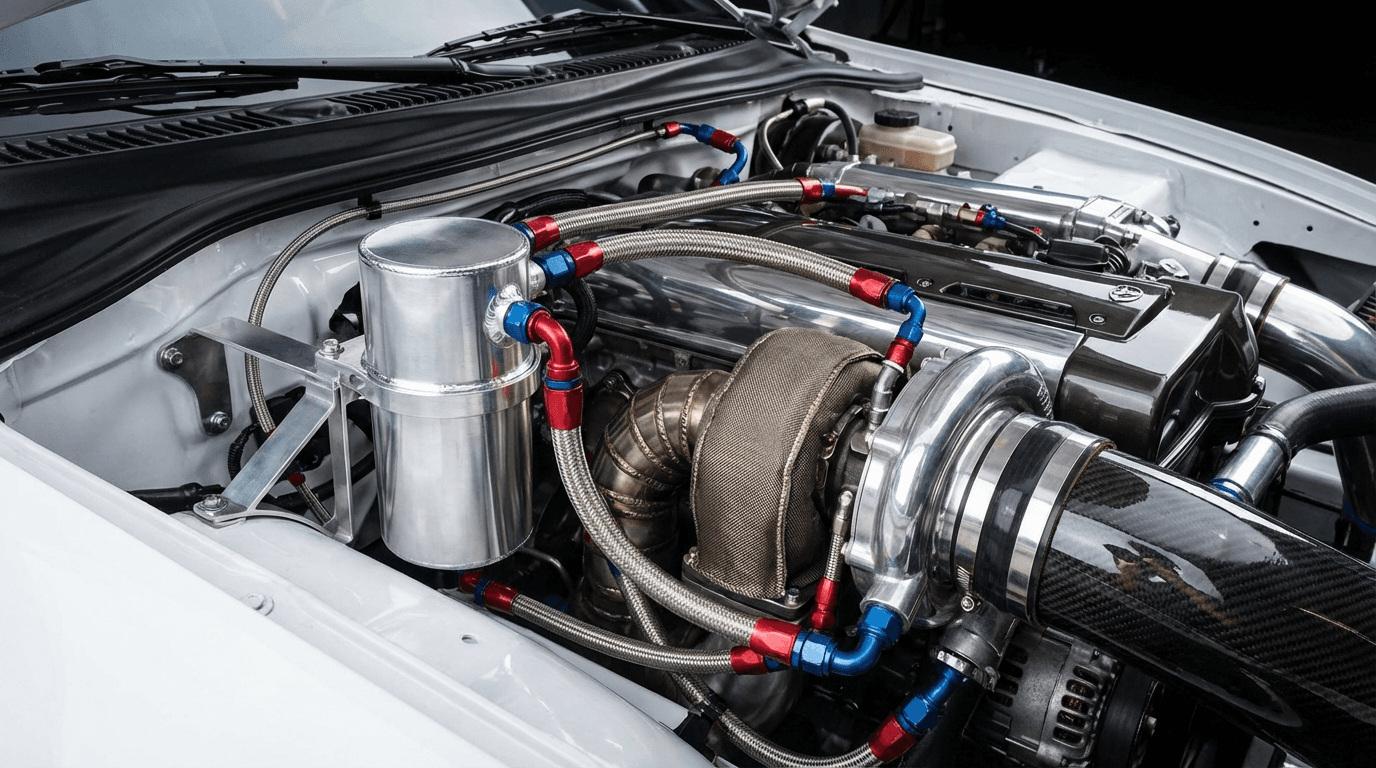
If you have spent any time in car modification forums, you have seen oil catch cans discussed — sometimes praised as essential, sometimes dismissed as unnecessary. The truth depends entirely on your car, your modifications, and how you drive. For turbocharged and direct-injection engines especially, a catch can is one of the most practical preventative modifications you can make.
This guide explains what blow-by is, how your car's PCV system works, what a catch can actually does, and whether your build needs one.
What Is Blow-By?
During combustion, the expanding gases in the cylinder push the piston down. But the seal between the piston rings and cylinder wall is not perfect — a small amount of combustion gas escapes past the piston rings and enters the crankcase. This escaped gas is called blow-by.
Blow-by contains:
- Oil vapour — Crankcase oil mist picked up by the turbulent gases
- Fuel vapour — Unburnt fuel that slipped past the rings
- Combustion byproducts — Water vapour, carbon particles, acidic compounds
On a stock engine with fresh rings, blow-by is minimal. But several factors increase it:
- Higher boost pressure forces more gas past the rings
- Worn piston rings (high-mileage engines) allow more blow-by
- Higher combustion temperatures from aggressive tunes increase ring seal degradation
- Direct injection (GDI/FSI) engines tend to have more blow-by than port-injected engines
The PCV System: What Your Car Does with Blow-By
The Positive Crankcase Ventilation (PCV) system routes blow-by gases from the crankcase back into the intake manifold. From there, they are drawn into the cylinders and burned during normal combustion. This is an emissions control measure — it prevents blow-by gases from being vented to atmosphere.
The Problem
The PCV system works fine on stock engines with modest blow-by. But the oil vapour in the blow-by coats the inside of the intake manifold, throttle body, intake valves, and intercooler piping with a layer of oily residue.
On port-injected engines, this is not a major issue because fuel sprayed onto the intake valves continuously washes away the deposits.
On direct-injection engines, fuel is sprayed directly into the cylinder — it never touches the intake valves. Over time, blow-by oil deposits bake onto the intake valves, forming carbon buildup that restricts airflow and reduces performance. This is the infamous "carbon buildup" problem that plagues GDI engines.
On turbocharged engines, the higher blow-by volume means more oil coating the intake tract, intercooler, and throttle body. The intercooler can accumulate a significant amount of oil over time, reducing its cooling efficiency.
What an Oil Catch Can Does
An oil catch can is a simple device installed in the PCV line between the crankcase breather and the intake manifold. It intercepts blow-by gases, separates the oil vapour from the air, and catches the oil in a container while allowing the cleaned air to continue to the intake.
How It Works
- Blow-by gases enter the catch can from the crankcase
- Inside the can, the gases pass through baffles, mesh screens, or centrifugal separators
- Oil droplets condense on the baffles and drain to the bottom of the can
- Cleaned air exits the can and continues to the intake manifold
- Collected oil accumulates in the can and is periodically drained
Types of Catch Cans
Basic baffled catch can — Uses internal baffles to slow the airflow and cause oil droplets to condense on surfaces. Simple and effective for mild blow-by.
- Price: RM 50 - RM 200
- Effectiveness: 60-80% oil separation
Multi-stage catch can — Uses multiple separation methods (baffles + mesh + filter). Better separation efficiency.
- Price: RM 200 - RM 600
- Effectiveness: 80-95% oil separation
Air-oil separator (AOS) — A more sophisticated version that uses centrifugal separation or fine mesh screens for maximum efficiency. Often returns separated oil to the engine via a drain line to the oil pan.
- Price: RM 500 - RM 2,000
- Effectiveness: 95-99% oil separation
Popular Catch Can Brands
| Brand | Type | Price Range | Notes |
|---|---|---|---|
| Mishimoto | Baffled | RM 300 - RM 600 | Good all-rounder, universal fit |
| Radium Engineering | Multi-stage | RM 400 - RM 800 | Excellent build quality |
| IAG | AOS | RM 800 - RM 1,500 | Popular for Subaru |
| RX | Budget | RM 50 - RM 150 | Basic baffled, Chinese made |
| OEM (BMW, Porsche) | Factory AOS | RM 500 - RM 2,000 | Some cars have factory solutions |
Do You Need a Catch Can?
Definitely Yes
- Direct-injection turbo engine — The combination of high blow-by and no fuel washing the intake valves makes a catch can essential for long-term engine health
- High-boost turbo build — More boost = more blow-by = more oil in the intake
- Track use — Sustained high RPM and load produce significantly more blow-by
- Engine making 300+ hp — Higher power levels stress rings more
Recommended
- Any turbocharged engine — Even mildly tuned turbo cars benefit
- Direct-injection NA engines — GDI engines with carbon buildup issues (BMW, VAG, Ford EcoBoost)
- High-mileage engines — Worn rings produce more blow-by
Probably Not Needed
- Stock port-injected NA engine — Low blow-by and fuel washing keeps valves clean
- Brand new engine with low miles — Minimal blow-by, but installing one early prevents future buildup
Installation
A basic catch can installation involves:
- Locate the PCV valve and crankcase breather hoses
- Cut the hose between the crankcase and intake manifold
- Route one end to the catch can inlet, the other from the catch can outlet
- Mount the catch can in the engine bay (bracket or zip ties)
- Check connections for leaks
Installation is straightforward and takes 30-60 minutes. Most catch cans come with universal fittings and hose. Some brands offer car-specific kits with model-specific brackets and pre-formed hoses.
Maintenance
You need to drain the catch can regularly. How often depends on your engine and driving:
- Street driving: Check every 1,000-2,000km, drain when visibly full
- Hard driving / track: Check after every session
- High-boost builds: Check frequently — a full catch can can restrict PCV flow
The fluid you drain is a nasty mix of oil, water, and fuel residue. It confirms that all of that would have gone into your intake without the catch can.
Catch Can vs Walnut Blasting
A catch can prevents future carbon buildup. But if your engine already has significant deposits (common on high-mileage GDI engines), you may need walnut blasting to clean the existing buildup from the intake valves. Walnut blasting uses crushed walnut shells blasted at high pressure to clean the valves without damaging them.
Typical cost: RM 500 - RM 1,200 for walnut blasting at a workshop.
After cleaning, install a catch can to prevent the buildup from returning.
For more on keeping your engine healthy with the right engine oil, check out our complete oil guide. And if you are running a turbo or supercharger, a catch can becomes even more important.
FAQ
Will a catch can void my warranty?
A catch can does not modify engine performance — it is a filtration device. Most dealers should not deny warranty claims based on a catch can alone. However, if the dealer attributes an issue to the catch can installation, they could attempt to deny the specific claim.
Can I just vent the crankcase to atmosphere instead?
Technically yes, but this is not recommended. Venting to atmosphere releases oil vapour and hydrocarbons into the environment and may fail emissions testing. It also creates an unpleasant smell and can leave oil residue on the underbody. A catch can is the proper solution.
How much oil does a catch can collect?
This varies wildly. A healthy stock engine might collect a few millilitres per 1,000km. A high-boost turbo engine can collect 30-50ml per 1,000km. An engine with worn rings can fill a catch can in a few hundred kilometres — in that case, the catch can is also telling you that your rings need attention.
Do I need one for each bank on a V-engine?
V-engines (V6, V8) typically have two crankcase breathers — one per bank. For complete protection, you should install a catch can on each line. Some catch cans have dual inlets to handle both lines with a single unit.