Carbon Fibre Parts Guide: Real vs Fake, Types, and What Is Worth Buying
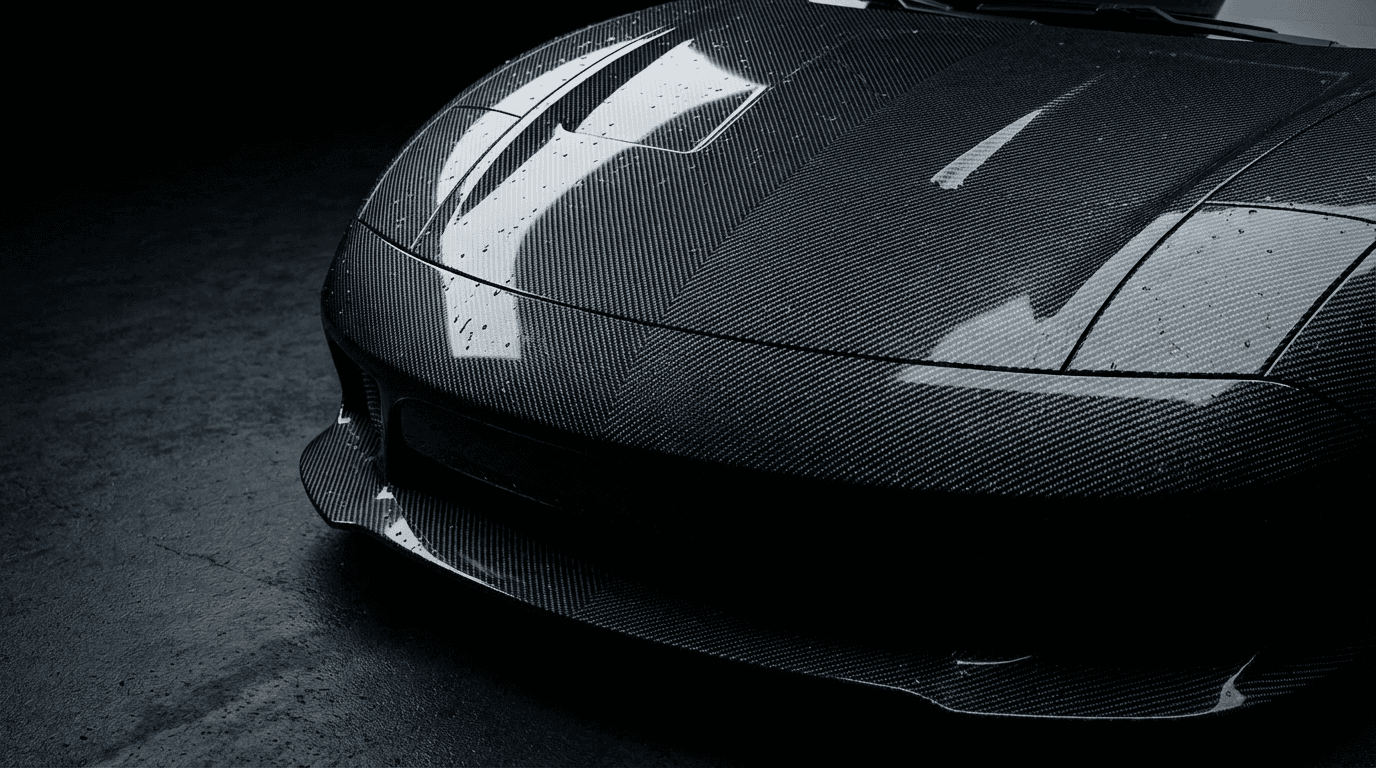
Carbon fibre has become the ultimate status material in car modification. A carbon fibre bonnet, spoiler, or mirror cover instantly signals that a build is serious. But the carbon fibre market is flooded with products ranging from genuine aerospace-grade dry carbon to cheap fibreglass with a printed carbon pattern stuck on top. Knowing the difference saves you money and ensures you get what you pay for.
This guide explains the different types of carbon fibre, how to identify real from fake, which parts benefit from carbon fibre, and what is worth the premium.
What Is Carbon Fibre?
Carbon fibre is a material made from thin strands of carbon atoms bonded together in a crystalline structure. These strands are woven into a fabric and then set in a resin matrix (usually epoxy) to create a composite material that is:
- Extremely strong — Higher tensile strength than steel
- Very light — About 5x lighter than steel, 1.5x lighter than aluminium
- Stiff — High rigidity with minimal flex
- Expensive — The raw material and manufacturing process are costly
The carbon fibre weave pattern you see on finished parts is not just decorative — it is the actual structural material. The resin holds the fibres in place and distributes loads between them.
Types of Carbon Fibre Construction
Wet Carbon (Hand-Laid)
The most common and affordable method. Carbon fibre fabric is laid into a mould by hand and liquid resin is applied with brushes or rollers. The part cures at room temperature or in a low-temperature oven.
Quality: Good to moderate. The resin content is harder to control, which means:
- Heavier than dry carbon (excess resin adds weight)
- Potential for air bubbles and voids in the laminate
- Inconsistent resin distribution
- Surface finish can vary
Price: 30-60% cheaper than dry carbon Weight saving vs stock: 20-40% lighter than equivalent steel/aluminium part
Dry Carbon (Prepreg / Autoclave)
The premium method. Carbon fibre fabric is pre-impregnated with precisely measured resin at the factory (hence "prepreg"). The part is laid into a mould, vacuum-bagged to remove air, and cured in an autoclave (a pressurised oven) at 120-180°C.
Quality: Excellent.
- Minimal resin content = lightest possible weight
- No air bubbles or voids
- Consistent, uniform laminate
- Superior strength-to-weight ratio
- Perfect surface finish
Price: 2-4x more expensive than wet carbon Weight saving vs stock: 40-60% lighter than equivalent steel/aluminium part
Forged Carbon
A relatively new process where short, chopped carbon fibres are mixed with resin and compression-moulded. The result is a distinctive swirled, marbled pattern instead of the traditional woven look. Lamborghini pioneered this technology.
Quality: Good strength, good weight savings, unique appearance Price: Similar to or slightly less than dry carbon Best for: Aesthetic parts where the marbled look is desired
Real Carbon Fibre vs Fake: How to Tell the Difference
Fake Carbon Fibre Products
Several types of "carbon fibre" products are not actually carbon fibre:
-
Carbon fibre print / hydro-dipped — A printed pattern applied to a plastic or fibreglass part. The pattern is on the surface only — there is no structural carbon fibre. Easily identified by the perfectly uniform pattern and plastic feel.
-
Carbon fibre vinyl wrap — Adhesive vinyl with a textured carbon pattern. Obviously fake up close but looks passable from a distance. Very cheap (RM 20-50 per metre).
-
Fibreglass with carbon fibre skin — A fibreglass part with a single layer of real carbon fibre on the visible surface for appearance. The structural material is fibreglass, not carbon fibre. Lighter than pure fibreglass but heavier than real carbon fibre.
How to Identify Real Carbon Fibre
| Test | Real Carbon Fibre | Fake / Print |
|---|---|---|
| Pattern consistency | Slight irregularities in the weave | Perfectly uniform, repeating pattern |
| Depth | You can see depth in the weave — fibres going over and under | Flat, printed-on pattern |
| Weight | Noticeably light for its size | Heavier than expected |
| Edge examination | Cut edges show layered carbon fibre plies | Smooth plastic or fibreglass edges |
| Tap test | Sounds hollow and resonant (like tapping a drum) | Sounds solid/dull |
| Burn test | Carbon fibre does not melt (it chars) | Plastic melts, fibreglass frays |
| Price | If it seems too cheap, it probably is | — |
Common Carbon Fibre Car Parts
Exterior
| Part | Weight Saving | Price Range | Worth It? |
|---|---|---|---|
| Bonnet (hood) | 5-15kg | RM 2,000 - RM 8,000 | Yes for track, debatable for street |
| Boot lid (trunk) | 3-8kg | RM 1,500 - RM 5,000 | Good value, easy swap |
| Roof panel | 5-10kg | RM 3,000 - RM 10,000 | Significant — lowers centre of gravity |
| Mirror covers | <0.5kg | RM 200 - RM 800 | Purely aesthetic |
| Front lip / splitter | 1-3kg | RM 500 - RM 3,000 | Functional aero + looks |
| Rear diffuser | 1-3kg | RM 800 - RM 4,000 | Functional on track |
| Spoiler / wing | 2-5kg | RM 1,000 - RM 5,000 | Functional + aesthetic |
| Side skirts | 1-3kg | RM 600 - RM 2,500 | Mostly aesthetic |
| Fender vents | <1kg | RM 300 - RM 1,000 | Functional if they vent air |
For more on body kits and aero components, read our complete body kit guide.
Interior
| Part | Weight Saving | Price Range | Worth It? |
|---|---|---|---|
| Steering wheel trim | Minimal | RM 200 - RM 600 | Aesthetic upgrade |
| Centre console trim | Minimal | RM 300 - RM 1,000 | Aesthetic upgrade |
| Door cards (full replacement) | 3-6kg per pair | RM 2,000 - RM 6,000 | Track cars — significant weight saving |
| Seat backs | 2-4kg per pair | RM 1,000 - RM 4,000 | Aesthetic, some weight saving |
Mechanical
| Part | Purpose | Price Range | Worth It? |
|---|---|---|---|
| Driveshaft | Weight + NVH reduction | RM 3,000 - RM 8,000 | Reduces rotational mass, track builds |
| Cold air intake | Heat shielding | RM 500 - RM 2,000 | Some benefit from heat insulation |
| Strut bar | Chassis stiffness | RM 400 - RM 1,500 | Functional |
| Exhaust tips | None (decorative) | RM 200 - RM 2,000 | Purely aesthetic |
Caring for Carbon Fibre Parts
UV Protection
The biggest enemy of carbon fibre in Malaysia is UV radiation from the sun. UV degrades the epoxy resin, causing:
- Yellowing of the clear coat
- Surface hazing and dullness
- Eventually, structural weakening of the resin matrix
Protection: Always apply UV-protective clear coat. Painted carbon fibre is fully protected. Exposed (clear-coated) carbon fibre needs quality UV-resistant clear coat and regular waxing or ceramic coating.
Cleaning
- Use mild car wash soap — no harsh chemicals
- Avoid abrasive polishing compounds on clear-coated carbon
- Wax or ceramic coat regularly to maintain the clear coat
Repair
Minor chips and scratches in the clear coat can be touched up. Structural damage (cracks, delamination) requires professional repair — carbon fibre cannot be simply welded like metal. Repairs involve cutting out the damaged area and laminating new carbon fibre over it.
When Carbon Fibre Is Worth the Premium
Worth It
-
Track cars where weight matters — Every kilogram saved improves lap times. A carbon bonnet + boot saves 10-20kg. A carbon roof lowers the centre of gravity.
-
Functional aero parts — Carbon fibre splitters, wings, and diffusers are lighter and stiffer than fibreglass alternatives. Stiffness matters for aero parts because flex at speed changes the aero profile.
-
When you want the look — If you love the carbon fibre aesthetic and are willing to pay for it, that is a valid reason. Just make sure you are buying real carbon, not a print.
Not Worth It (Usually)
-
Interior trim pieces on street cars — Carbon fibre dash trim, door handle covers, and similar small pieces add minimal weight savings at significant cost. These are purely aesthetic.
-
Mirror covers — Unless they are part of a complete exterior carbon package, carbon mirror covers save virtually no weight. They are purely cosmetic.
-
Exhaust tips — Carbon fibre exhaust tips serve zero performance purpose. They look good but that is all.
-
When budget is tight — If the carbon fibre premium means you cannot afford other more impactful modifications, spend elsewhere first. A set of quality tyres improves performance more than a carbon bonnet.
FAQ
Is dry carbon always better than wet carbon?
For pure weight savings and structural integrity, yes. But wet carbon is perfectly adequate for most street applications. If you are not tracking the car competitively, wet carbon saves you 50-70% of the cost with 70-80% of the weight savings.
Will carbon fibre crack in an accident?
Carbon fibre does not deform like metal — it fractures. In a crash, carbon fibre parts shatter rather than dent. This is fine for panels (which are replaceable) but is why carbon fibre is not used for energy-absorbing crash structures on road cars.
Can I paint carbon fibre?
Yes. Many OEM carbon parts come colour-matched (like BMW M Performance parts). If you want the carbon weave visible, use a clear coat. If you want it colour-matched, paint over it.
How do I clean yellowed carbon fibre?
Light yellowing can be addressed with a mild polish and fresh UV clear coat. Heavy yellowing usually requires stripping the old clear coat and reapplying. Prevention (UV protection) is far easier than cure.