Blow-Off Valves and Wastegates: The Complete Guide
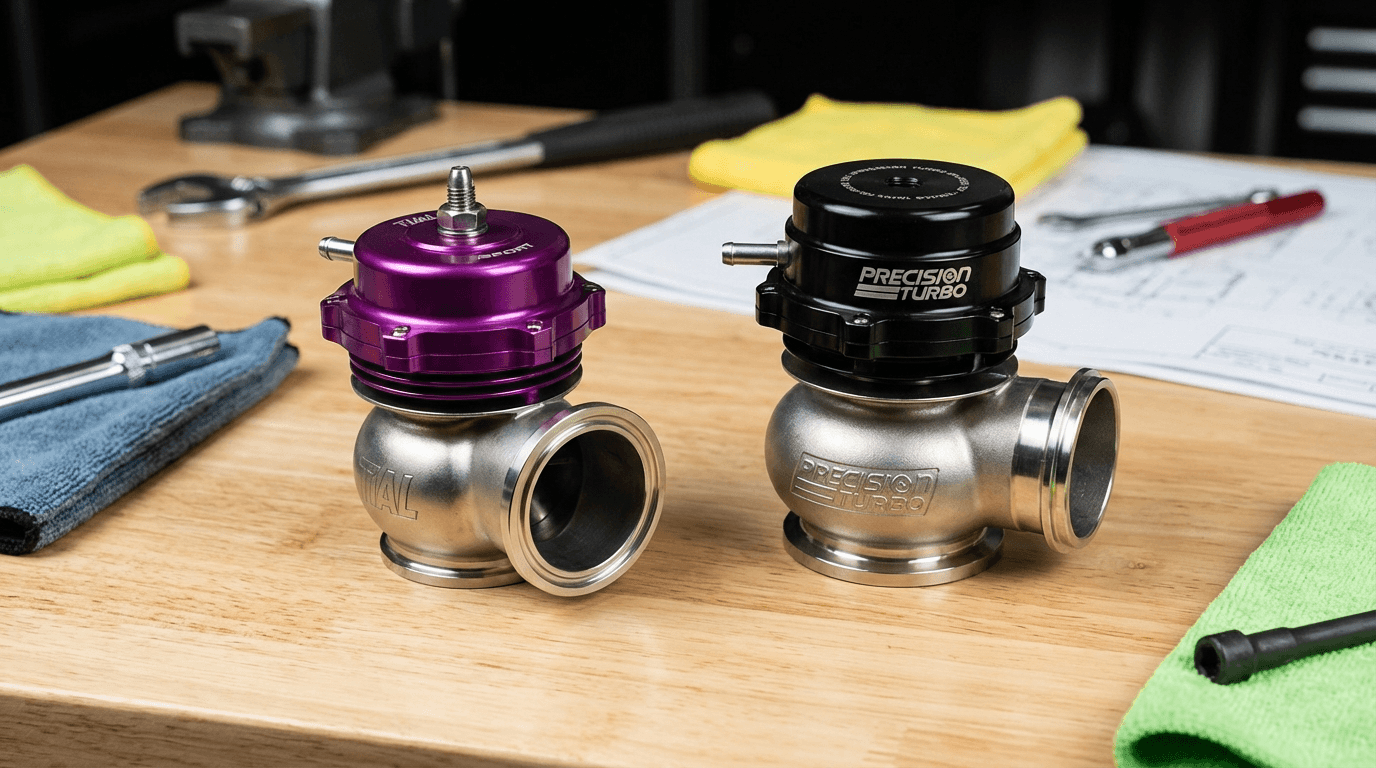
If you own a turbocharged car, two components are critical to protecting your turbo system: the blow-off valve (BOV) and the wastegate. Both are pressure relief devices, but they work on different sides of the turbo and serve different purposes. Understanding them is essential for any turbo build — especially if you are increasing boost pressure.
This guide explains how both devices work, the different types available, and which upgrades matter for your build.
Blow-Off Valve (BOV): Protecting the Compressor Side
What a BOV Does
When you are on boost and suddenly lift off the throttle (gear change, backing off), the throttle plate closes but the turbo is still spinning at full speed, pushing compressed air. This air has nowhere to go — the throttle is closed and the turbo is still compressing.
Without a BOV, this trapped pressure creates a surge of compressed air that pushes back against the compressor wheel. This is called compressor surge — you can hear it as a fluttering or chattering sound from the turbo. Compressor surge:
- Slows the turbo dramatically (kills spool between gear changes)
- Puts stress on the compressor wheel bearings and shaft
- Can damage the compressor wheel over time
A BOV opens when the throttle closes, venting the excess compressed air before it can surge back against the compressor. This protects the turbo and allows it to maintain speed between gear changes for faster boost recovery.
Vent-to-Atmosphere (VTA) BOV
A VTA blow-off valve vents the excess air directly to atmosphere — producing the iconic "psshh" or "whoosh" sound that many enthusiasts love.
Pros:
- The sound — unmistakable turbo sound effect
- Simple — air goes out, done
- Eliminates compressor surge completely
Cons:
- On cars with a mass airflow sensor (MAF), venting metered air to atmosphere can cause the engine to run rich momentarily (the ECU has already measured that air and injected fuel for it, but now the air is gone)
- Some factory ECUs will trigger a check engine light (CEL)
- Louder — which can be a pro or a con
Price: RM 200 - RM 1,500
Recirculating BOV (Bypass Valve / Diverter Valve)
A recirculating BOV routes the excess air back into the intake tract (before the turbo compressor inlet) rather than venting it to atmosphere. This is what most factory turbo cars use.
Pros:
- No MAF metering issues (air stays in the system)
- No CEL or running issues
- Quieter (mostly internal whoosh)
- Better for emissions compliance
Cons:
- No dramatic "psshh" sound
- Slightly slower compressor wheel speed maintenance (recycled air is warm, which is less efficient)
Price: RM 200 - RM 1,200
Hybrid BOV
Some aftermarket BOVs offer both VTA and recirculating modes — you can switch between them or run in a hybrid mode that vents some air to atmosphere and recirculates the rest. This gives you the sound when you want it and quiet operation when you do not.
Price: RM 300 - RM 1,500
When to Upgrade Your BOV
The factory bypass valve on most turbo cars is adequate for stock and Stage 1 boost levels. Upgrade when:
- You increase boost significantly (Stage 2+) — the factory valve may not flow enough air or may not hold closed under higher boost pressures (boost leak from the BOV)
- The factory valve is wearing out — rubber diaphragm BOVs deteriorate over time, causing boost leaks
- You want the sound — upgrading to a VTA BOV for the turbo sound is one of the most popular turbo car modifications
Popular BOV Brands
| Brand | Type | Price Range | Notes |
|---|---|---|---|
| Turbosmart | VTA, recirculating, hybrid | RM 400 - RM 1,200 | Industry leader, excellent quality |
| GReddy | VTA | RM 300 - RM 800 | Iconic Japanese design |
| HKS | VTA, recirculating | RM 300 - RM 1,000 | Japanese, popular on JDM cars |
| Forge Motorsport | Recirculating, hybrid | RM 400 - RM 1,000 | Great for European cars (VAG, BMW) |
| Tial | VTA | RM 500 - RM 1,200 | Premium, popular on big turbo builds |
Wastegate: Controlling Boost Pressure
While the BOV works on the intake (compressor) side, the wastegate works on the exhaust (turbine) side. Its job is to limit how much boost the turbo produces by bypassing exhaust gases around the turbine.
For a detailed guide on how wastegates interact with boost controllers, read our complete boost controller guide.
Internal Wastegate
An internal wastegate is built into the turbo's turbine housing. A small flap opens to divert exhaust gas away from the turbine wheel when boost reaches the target pressure.
Found on: Most factory turbo cars, smaller aftermarket turbos Flow capacity: Limited — adequate for stock boost but can cause boost creep at higher power levels Pros: Compact, no additional plumbing, simpler installation Cons: Limited flow, less precise control at high boost, cannot be upgraded independently
External Wastegate
An external wastegate is a separate unit mounted on the exhaust manifold. It has its own exhaust gas inlet and outlet (dump pipe) and operates independently of the turbo housing.
Found on: Performance builds, big turbo setups, motorsport applications Flow capacity: Much greater than internal — sizes range from 38mm to 60mm Pros: Precise boost control, handles high exhaust gas flow, independently adjustable spring pressure Cons: More complex installation, requires dump pipe routing, additional cost
When to Upgrade Your Wastegate
- Big turbo upgrade — A larger turbo produces more exhaust flow. If the internal wastegate cannot flow enough exhaust gas to control boost, you get boost creep (uncontrolled boost rise). An external wastegate is the solution.
- High boost targets — Above 1.5 bar (22 psi), most internal wastegates struggle to maintain precise control.
- Boost creep issues — If your boost keeps climbing past the target at high RPM despite a properly functioning boost controller, the wastegate cannot flow enough.
External Wastegate Sizing
| Wastegate Size | Flow Capacity | Suitable For |
|---|---|---|
| 38mm | Moderate | Up to 400 hp, stock turbo frames |
| 44mm | Good | 400-600 hp, medium turbo builds |
| 46mm | Very good | 500-800 hp, big turbo builds |
| 60mm | Excellent | 800+ hp, extreme builds |
Wastegate Springs
External wastegates use interchangeable springs to set the base boost pressure. Lower spring pressure = lower base boost. The boost controller then adds boost above the spring pressure.
Common spring pressures:
- 7 psi (0.5 bar) — Low base boost, controller adds the rest
- 10 psi (0.7 bar) — Common base for street turbo builds
- 14 psi (1.0 bar) — Higher base for performance builds
BOV vs Wastegate: Quick Reference
| Feature | Blow-Off Valve | Wastegate |
|---|---|---|
| Side of turbo | Compressor (intake) | Turbine (exhaust) |
| Purpose | Prevent compressor surge on throttle lift | Control maximum boost pressure |
| When it opens | When throttle closes | When boost reaches target |
| What it vents | Compressed intake air | Exhaust gas |
| Sound | "Psshh" (VTA) or quiet (recirculating) | Exhaust note change, screamer pipe |
| Upgrade priority | After increasing boost or for sound | When running big turbo or high boost |
Screamer Pipes and Dump Pipes
When an external wastegate opens, the bypassed exhaust gas needs to go somewhere. A dump pipe routes this gas either:
- Back into the exhaust (recirculated) — Quieter, emissions-friendly
- To atmosphere (screamer pipe) — Very loud, unmistakable high-pitched scream when on boost. The "screamer pipe" name comes from the sound.
Screamer pipes are primarily used in motorsport. On the street, they are extremely loud and typically not legal. A recirculated dump pipe that merges back into the downpipe or exhaust is the street-friendly solution.
For more on exhaust system integration, see our exhaust systems guide and intercooler guide.
FAQ
Will a VTA blow-off valve cause a check engine light?
On MAF-metered cars (most modern turbo cars), a VTA BOV can cause momentary rich running when the valve vents. Some ECUs tolerate this, others throw a CEL. Cars with MAP-only metering (less common) have no issue with VTA. Check forums for your specific car before buying.
Can I just delete the blow-off valve entirely?
Removing the BOV exposes the turbo to compressor surge on every throttle lift. On small turbos with mild boost, this may not cause immediate damage, but it shortens turbo life. On high-boost builds with large turbos, compressor surge can damage the compressor wheel. Keep the BOV.
Do I need an external wastegate?
For stock or mildly tuned turbo cars, the factory internal wastegate is fine. You need an external wastegate when the internal one cannot flow enough exhaust gas to control boost — typically on big turbo builds making 400+ hp or when experiencing boost creep.
Why does my BOV leak boost?
Common causes: worn diaphragm (rubber BOVs), weak spring pressure (aftermarket BOVs set too soft), or the piston sealing surface is dirty or damaged. Replacing or rebuilding the BOV usually fixes the issue.
What size BOV do I need?
For stock turbo frames and up to 400 hp, most standard aftermarket BOVs (like Turbosmart Kompact or HKS SSQV) are adequate. For larger turbos and higher power, larger BOVs with bigger valve areas are needed to flow the increased volume of compressed air.