Strut Bars and Tower Braces: Do They Actually Improve Handling?
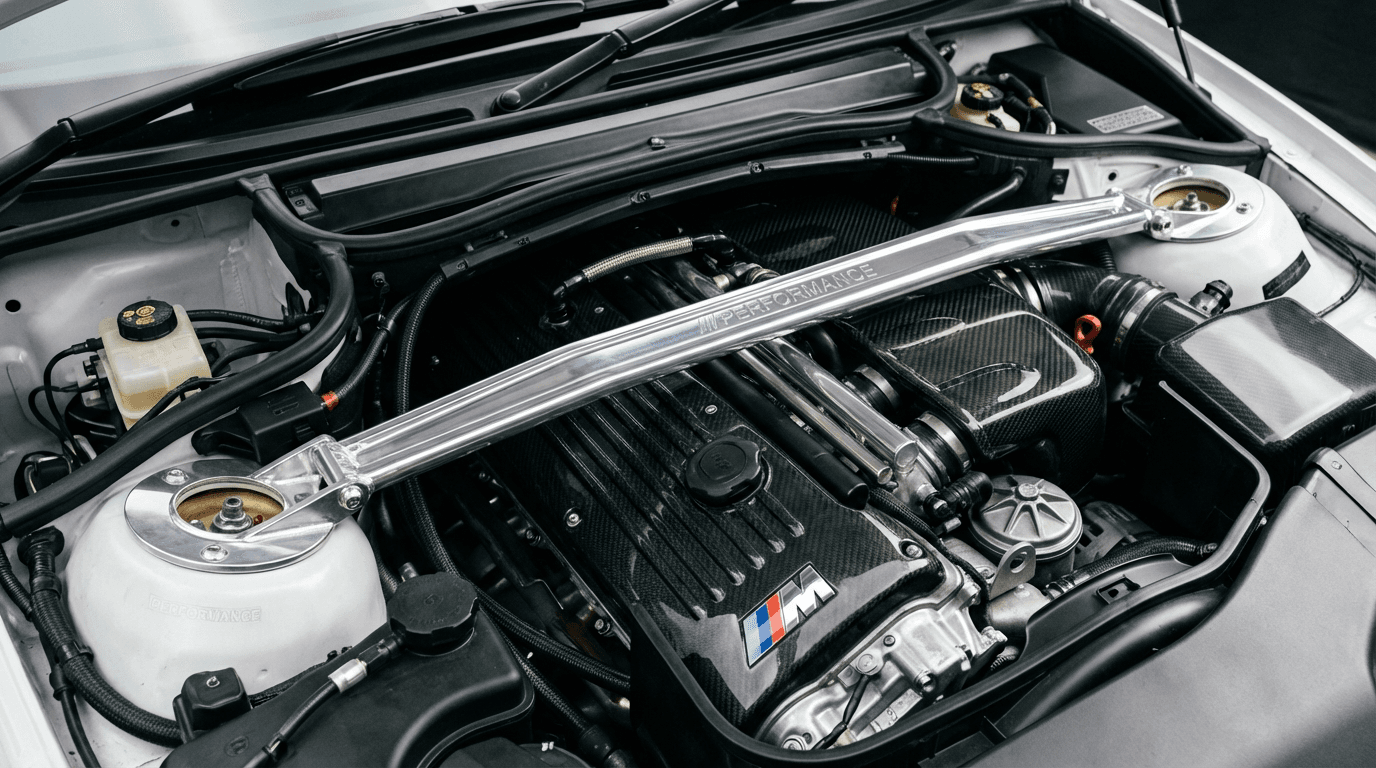
Strut bars are one of the most popular and affordable handling modifications — but also one of the most debated. Some enthusiasts swear they transform a car's handling. Others dismiss them as expensive dress-up items that do nothing. The truth, as usual, is somewhere in between and depends on your specific car, your other modifications, and how you drive.
This guide explains what strut bars actually do, which types work, when they matter, and when they are a waste of money.
What a Strut Bar Does
A strut bar (also called a strut tower brace, tower bar, or brace bar) is a rigid bar that connects the tops of the two front (or rear) strut towers. It physically ties the two suspension mounting points together across the engine bay.
Why This Matters
When you corner, the suspension on the loaded (outside) wheel compresses while the unloaded (inside) wheel extends. These forces push and pull on the strut towers in opposite directions. On a car with a flexible chassis, this causes the strut towers to deflect — they move slightly inward on the loaded side and outward on the unloaded side.
This flex means the suspension geometry changes during cornering — camber, caster, and toe all shift slightly from their set values. The result is inconsistent handling — the car does not respond the same way at every turn because the chassis is flexing differently depending on the load.
A strut bar prevents this by locking the two strut towers together. When one tower tries to flex, the bar transfers the force to the other tower, keeping both in position. The suspension geometry stays consistent, and the car handles more predictably.
The Real-World Effect
On cars where the chassis is already very stiff (modern sports cars, cars with extensive factory bracing), a strut bar may provide minimal improvement because the towers are not flexing significantly.
On cars with less rigid unibody construction (older cars, economy cars, convertibles, cars with the firewall cut for right-hand-drive conversion), a strut bar can make a noticeable difference in:
- Steering precision — More direct, less vague on turn-in
- Mid-corner stability — Car feels more planted and predictable
- Turn-in response — Sharper initial response when you turn the wheel
- Consistency — Same handling feel regardless of cornering load
Types of Strut Bars and Braces
Front Strut Tower Bar
The most common type. Connects the front strut towers across the engine bay.
Effect: Improves front-end rigidity, sharper steering, more predictable turn-in Price: RM 150 - RM 800 Installation: 10-30 minutes, bolts to existing strut tower bolts
Rear Strut Tower Bar
Connects the rear strut towers across the boot/trunk area.
Effect: Improves rear-end stability, more planted rear in corners Price: RM 150 - RM 600 Installation: 10-30 minutes, may reduce boot space slightly
Lower Arm Brace
Connects the lower suspension mounting points (subframe or lower control arm mounts) underneath the car.
Effect: Often more effective than upper strut bars because lower mounting points experience higher forces. Improves overall chassis rigidity. Price: RM 200 - RM 1,000 Installation: Requires car on a lift, bolts to underside mounting points
Fender Braces
Connect the strut tower to the firewall or fender mounting points. Address flex between the strut tower and the rest of the chassis.
Effect: Works synergistically with strut bars — the strut bar stops lateral flex, fender braces stop fore-aft flex Price: RM 200 - RM 800 Installation: 30-60 minutes
Mid-Chassis Braces
X-braces, K-braces, or rail braces that bolt to the underside of the car, connecting various chassis mounting points.
Effect: Significant improvement in overall chassis rigidity. More effective than any single-point brace. Price: RM 400 - RM 2,000 Installation: Requires lift, 1-2 hours
For more extensive chassis reinforcement including roll cages and safety equipment, read our anti-roll bars and chassis bracing guide.
Do Strut Bars Actually Work?
When They Make a Big Difference
-
Older cars — Cars designed before modern computer-optimised chassis engineering (pre-2005ish) often have meaningful flex. Strut bars are very noticeable on these platforms.
-
Economy cars modified for performance — A Perodua Myvi or Proton Saga was not designed for aggressive cornering. The chassis flex is significant, and bracing helps.
-
Convertibles — Removing the roof removes a major structural element. Convertibles are inherently less rigid than their coupe counterparts, and bracing is more beneficial.
-
Cars with coilover suspension — Stiffer springs and dampers put more load into the chassis. If you have upgraded to coilovers, the chassis flex that was masked by soft stock suspension becomes more apparent.
-
Track use — Higher sustained cornering loads mean more chassis flex. The consistency benefit matters when you are pushing the car to its limits lap after lap.
When They Make Minimal Difference
-
Modern stiff sports cars — A BMW M3, Porsche Cayman, or Honda Civic Type R already has extensive factory bracing. Adding a strut bar to an already-rigid car yields diminishing returns.
-
Casual street driving — At normal street speeds and cornering loads, chassis flex is minimal regardless of the car. You will not notice a strut bar during your daily commute.
-
Stock suspension — If the car is on soft factory suspension, the springs and dampers absorb forces before they reach the chassis. Stiffer suspension (coilovers) is prerequisite for bracing to matter.
Construction Quality Matters
Not all strut bars are created equal:
Rigid (one-piece) bars — A solid bar with no joints or adjustability. The most effective design because there is no flex in the bar itself. Best for cars where the strut tower spacing does not change.
Adjustable (two-piece with turnbuckle) bars — Two halves connected by a threaded centre section. Allows length adjustment to fit different cars. The threaded joint introduces a small amount of flex — less effective than a rigid bar, but more versatile.
Hinged/pivoting bars — Some bars have a pivot joint to allow for engine movement. These are largely decorative — a pivoting joint defeats the purpose of rigidity.
Material
| Material | Stiffness | Weight | Price |
|---|---|---|---|
| Steel | Highest | Heaviest | Budget |
| Aluminium | Good | Light | Mid-range |
| Carbon fibre | Good | Lightest | Premium |
| Titanium | Excellent | Very light | Premium |
For most applications, an aluminium bar offers the best balance of stiffness, weight, and value.
The Complete Chassis Bracing Package
For maximum effect, combine multiple bracing points. Each brace works synergistically with the others — the whole is greater than the sum of the parts.
Recommended order:
- Front strut bar (RM 200-800) — easiest, most noticeable
- Lower arm brace (RM 300-1,000) — addresses higher-load mounting points
- Rear strut bar (RM 150-600) — completes the upper bracing
- Mid-chassis brace (RM 400-2,000) — ties everything together
Total investment: RM 1,000 - RM 4,000 for a comprehensive bracing package
Combined with proper coilovers and understanding your drivetrain type, chassis bracing is a meaningful handling upgrade.
FAQ
Can a strut bar damage my car?
No, a properly installed strut bar cannot damage the car. It bolts to existing mounting points and can be removed without leaving permanent changes. Some people worry that a strut bar transfers crash forces across the car — in a severe frontal impact, the bar could theoretically transfer forces to the opposite strut tower, but this is not a practical concern for street use.
Should I get a front or rear strut bar first?
Front strut bar first. Front suspension handles steering loads, which are the primary source of chassis flex during cornering. The front bar gives the most immediate improvement in steering feel and turn-in precision.
Do I need a strut bar if I have coilovers?
You do not "need" one, but coilovers and strut bars complement each other. Coilovers increase the loads going into the chassis (stiffer springs = more force transferred). A strut bar ensures the chassis handles those loads without flexing. If you have invested in quality coilovers, a strut bar helps you get the full benefit.
Will a strut bar make my ride harsher?
No. A strut bar does not change spring rate, damping, or suspension travel. It does not affect ride quality over bumps. It only affects how the chassis responds to cornering loads.