Lowering Springs vs Coilovers: Which Is Right for Your Car?
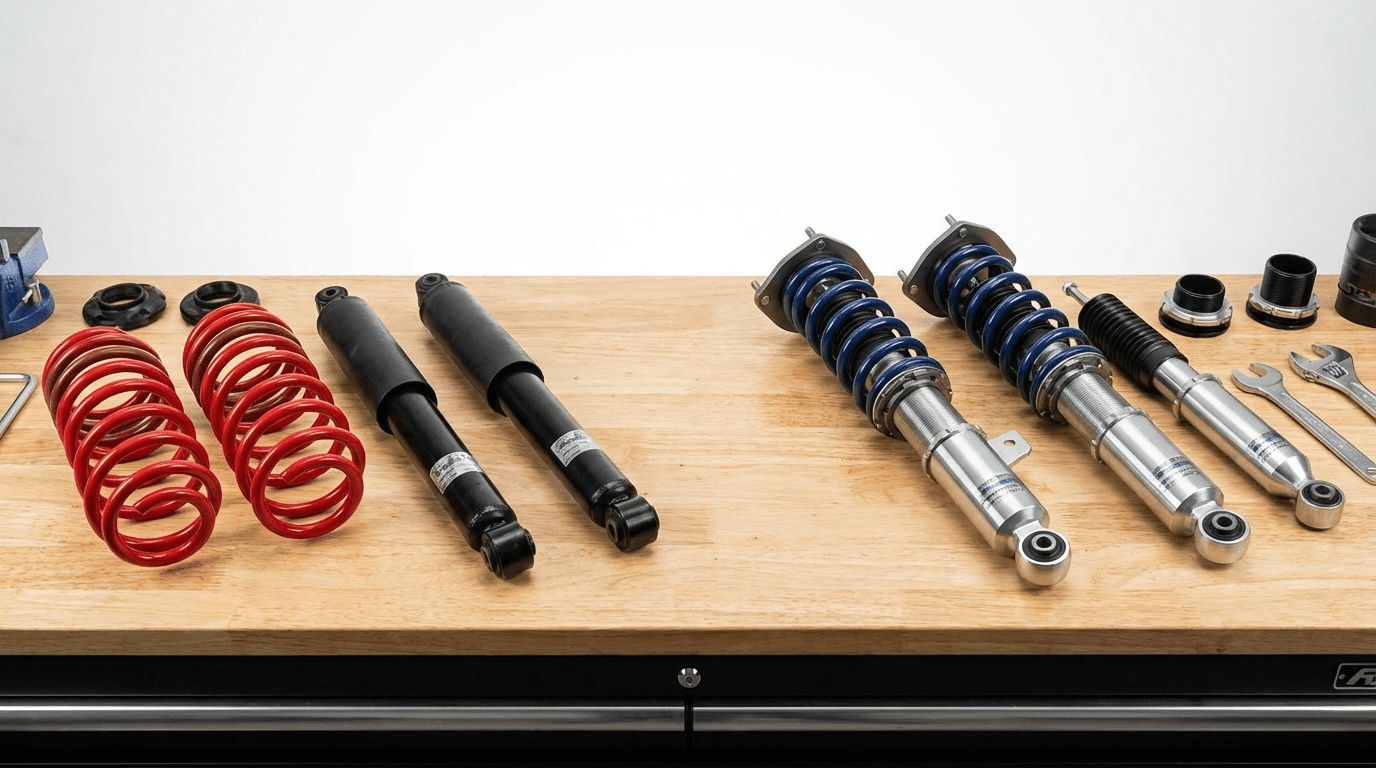
If you want to lower your car, you have two main options: lowering springs or coilovers. Both achieve a lower ride height, but they do it differently and at very different price points. This is one of the most common questions in car modification, and the answer depends on your goals, budget, and how seriously you want to pursue handling performance.
This guide provides a thorough comparison to help you make the right choice.
The Fundamental Difference
Lowering Springs
Lowering springs replace your factory springs while keeping your factory shock absorbers (dampers). They are shorter and stiffer than stock springs, which lowers the car and reduces body roll.
What you keep: Factory dampers, factory top mounts What you replace: Springs only Drop range: Typically 20-40mm (fixed, non-adjustable) Cost: RM 400 - RM 1,500 for a set of four springs
Coilovers
Coilovers replace both the springs AND the dampers as a complete assembly. They are purpose-built suspension units with adjustable ride height (at minimum) and often adjustable damping.
What you replace: Springs + dampers + sometimes top mounts Drop range: Typically 20-80mm+ (adjustable via threaded body) Cost: RM 1,500 - RM 15,000+ depending on quality and adjustability
For a deep dive into coilover technology, damping adjustability, and spring rates, read our complete coilover guide.
The Full Comparison
Ride Quality
Lowering springs on factory dampers: This is where the fundamental compromise lies. Lowering springs are stiffer than stock springs. But the factory dampers were designed to work with the factory spring rate. When you pair stiffer springs with dampers calibrated for softer springs, the dampers cannot properly control the spring — they are under-damped for the spring rate.
The result:
- Bouncy ride over bumps (damper cannot control spring rebound)
- Less composed over rough roads
- Damper life is shortened (working outside its design envelope)
Coilovers: A quality coilover set has springs and dampers engineered to work together. The damping is matched to the spring rate, which means the suspension is properly controlled across its entire travel range. The ride can be stiffer than stock (depending on the coilover and spring rate) but it feels composed and controlled rather than bouncy.
Verdict: Coilovers provide a significantly better ride quality for a given drop amount. Lowering springs compromise ride quality inherently due to the spring/damper mismatch.
Handling
Lowering springs: Lowering the car's centre of gravity improves handling. Stiffer springs reduce body roll. However, the under-damped condition means the car is less predictable during transitions and over mid-corner bumps. The improvement over stock is noticeable but inconsistent.
Coilovers: Properly matched spring rate and damping means the suspension responds predictably and consistently. Adjustable damping (on 1-way+ coilovers) lets you tune the ride for different conditions — softer for daily driving, firmer for track days. The handling improvement is dramatically better than lowering springs.
Verdict: Coilovers are categorically better for handling. If handling is your priority, coilovers are the only serious option.
Adjustability
Lowering springs: Zero adjustability. The drop amount and spring rate are fixed. If you do not like the ride height or stiffness, you need different springs.
Coilovers: Adjustable ride height (all coilovers). Many also offer:
- 1-way damping adjustment (compression and rebound together)
- 2-way damping adjustment (compression and rebound separately)
- 3-way+ adjustment (high-speed and low-speed compression/rebound)
- Adjustable spring preload
Verdict: Coilovers are infinitely more adjustable. This matters because your preferences may change, you might want different settings for different situations, and proper wheel alignment often requires fine-tuning ride height.
Cost
Lowering springs (parts only):
| Quality | Price | Examples |
|---|---|---|
| Budget | RM 400 - RM 700 | H&R Sport, Eibach Sportline |
| Mid-range | RM 700 - RM 1,200 | Eibach Pro-Kit, H&R OE Sport |
| Premium | RM 1,200 - RM 1,500 | Swift Sport, Hyperco |
Coilovers (parts only):
| Quality | Price | Examples |
|---|---|---|
| Budget | RM 1,500 - RM 3,000 | BC Racing BR, Megan Racing |
| Mid-range | RM 3,000 - RM 6,000 | BC Racing ER, KW V1, Bilstein B14 |
| Performance | RM 6,000 - RM 12,000 | KW V3, Ohlins Road & Track |
| Pro | RM 12,000 - RM 25,000+ | JRZ RS Pro, Ohlins TTX, MCS |
Installation cost: Similar for both — RM 200-500 for a workshop to install a set of springs or coilovers.
Verdict: Lowering springs are significantly cheaper. If budget is the primary constraint, springs are a valid starting point.
Longevity and Damper Wear
Lowering springs with factory dampers: The factory dampers wear out faster because they are operating outside their design parameters. Expect damper replacement within 30,000-50,000km (vs 80,000-120,000km on stock springs). At that point, you need new dampers — and if you buy quality replacement dampers matched to the lowering springs, you have effectively spent close to coilover money in two stages.
Coilovers: Quality coilovers last 50,000-100,000km+ depending on usage. Many performance coilovers (KW, Ohlins, JRZ) are rebuildable — you send them in for a rebuild (RM 500-1,500 per pair) and they come back good as new. Over the life of the car, rebuildable coilovers can be more cost-effective.
Verdict: Coilovers last longer and are rebuildable. Lowering springs shorten factory damper life, creating a hidden future cost.
Daily Drivability
Lowering springs: The bouncy ride on rough roads is the main daily-driving compromise. On smooth highways, lowered springs feel fine. On Malaysia's varied road surfaces (speed bumps, potholes, drainage gratings), the under-damped ride can be fatiguing.
Coilovers: Adjustable coilovers can be set softer for daily driving and firmed up for spirited driving. Even non-adjustable coilovers feel more composed because the damping matches the spring rate.
Verdict: Coilovers are better for daily driving, especially on Malaysian roads. The matched damping makes a huge difference on imperfect surfaces.
When Lowering Springs Make Sense
Despite the advantages of coilovers, there are legitimate reasons to choose lowering springs:
-
Tight budget — You want to lower the car and RM 500-800 is your limit. Lowering springs deliver a noticeable visual and handling improvement at a fraction of coilover cost.
-
Mild aesthetic lowering — You just want to close the wheel gap by 20-30mm for a better stance, and you do not care about track performance. A set of Eibach Pro-Kits on stock dampers looks great and rides acceptably.
-
Temporary setup — You plan to buy coilovers in the future but want to lower the car now. Lowering springs are a stop-gap.
-
Car does not have coilover options — Some less popular cars do not have aftermarket coilovers available. Lowering springs may be the only option.
When Coilovers Are Worth It
-
You care about handling — If you drive spirited backroads, attend track days, or simply want your car to handle as well as it can, coilovers are the correct choice. No question.
-
You want adjustability — Being able to raise the car for road trips and lower it for shows/track is invaluable.
-
Long-term ownership — If you plan to keep the car for 3+ years, coilovers are more cost-effective than springs + eventual damper replacement.
-
You track the car — Track days require properly matched suspension. Lowering springs on stock dampers will overheat and fade within a few laps.
-
You are doing other handling mods — If you are also upgrading anti-roll bars, brakes, and tyres, coilovers are the foundation that ties everything together.
The Upgrade Path
If budget is a concern, consider this approach:
- Start with lowering springs — Get the look and a modest handling improvement now (RM 500-800)
- Save for coilovers — When the factory dampers need replacement (which will happen sooner with lowering springs), invest in coilovers instead of replacement dampers
- Sell the lowering springs — Lowering springs hold their resale value well
This way you get the immediate benefit of lowering while saving toward the proper solution.
FAQ
Can I put lowering springs on worn dampers?
No. If your factory dampers are already worn (bouncy ride, leaking oil, high mileage), lowering springs will make the ride even worse. Replace or rebuild the dampers first, or just go directly to coilovers.
How low can I go with springs?
Most lowering springs drop 20-40mm. Going lower than 40mm on factory dampers is risky — the damper runs out of compression travel and can bottom out, which damages the damper and gives a terrible ride. For drops beyond 40mm, coilovers are necessary.
Do I need an alignment after lowering?
Yes. Lowering changes the suspension geometry, which affects camber, toe, and caster. An alignment is essential after any ride height change.
Will lowering void my warranty?
Potentially. If a suspension-related component fails and the dealer can attribute it to the lowering springs, they may deny that specific warranty claim. A full aftermarket coilover replacement similarly affects warranty — the key is whether the modification caused the specific failure.
Are budget coilovers better than quality lowering springs?
Not necessarily. The cheapest coilovers (under RM 1,500) can have poor damper quality and ride worse than quality lowering springs on good factory dampers. If you can only afford the absolute cheapest coilovers, quality lowering springs might actually ride better. Aim for at least the RM 2,500-3,000 range for coilovers that are genuinely better than springs.