Exhaust Headers and Manifolds: The Complete Upgrade Guide
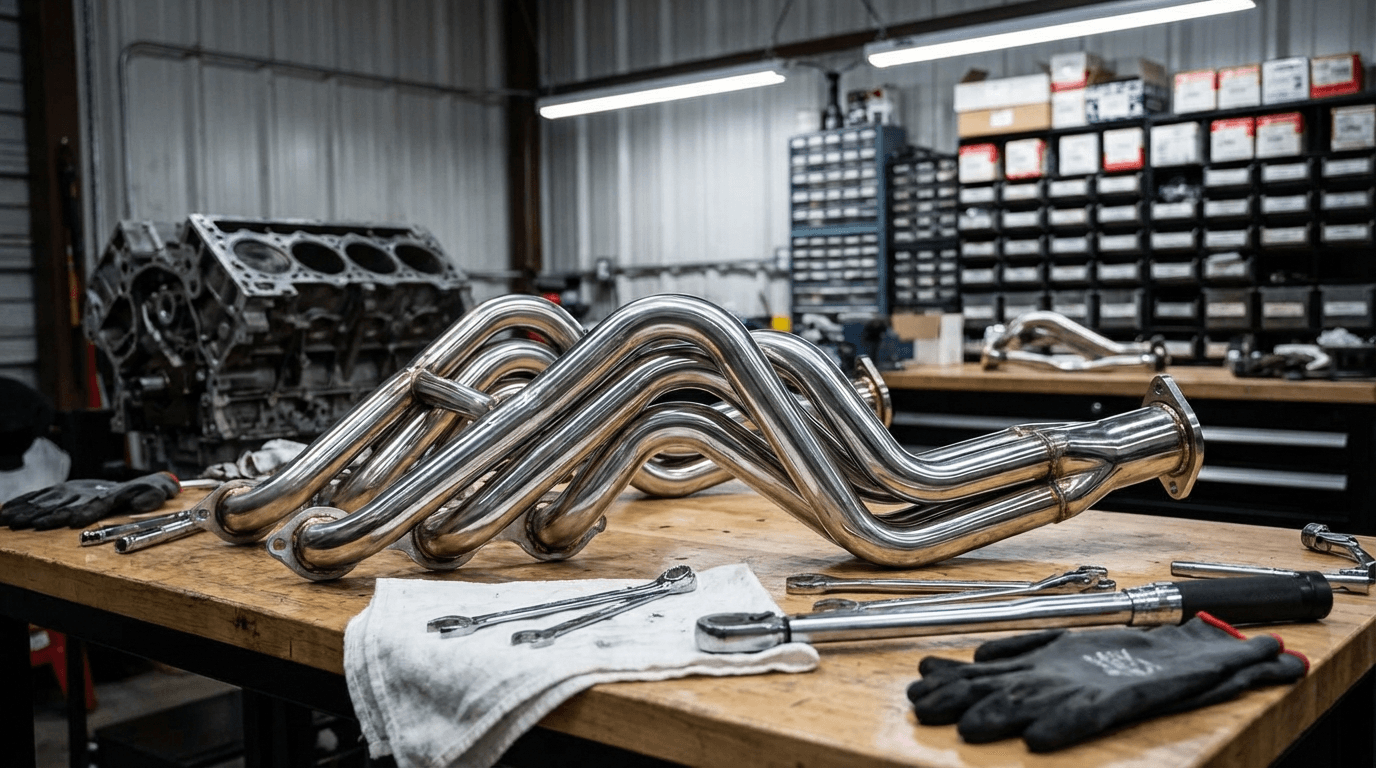
The exhaust manifold is the first component in your exhaust system — it bolts directly to the engine's cylinder head and collects the hot exhaust gases from each cylinder. On most factory cars, the manifold is a simple, cheap cast-iron piece designed for cost and durability, not for performance. Replacing it with an aftermarket header is one of the most effective ways to unlock power from a naturally aspirated engine, and on turbocharged cars, upgrading the turbo manifold can support bigger turbos and higher power levels.
This guide builds on our complete exhaust systems guide by diving deep into the header and manifold specifically — the component that has the biggest impact on exhaust flow and engine breathing.
How Exhaust Headers Work
The Problem with Stock Manifolds
A factory exhaust manifold is typically a single casting with short, cramped runners that merge into a common collector. It is designed to be:
- Cheap to manufacture (single cast iron piece)
- Compact (fits tight engine bays)
- Durable (cast iron withstands heat cycles)
- Quiet (short runners reduce high-frequency noise)
What it is not designed for is optimal exhaust flow. The short, unequal-length runners create turbulence where gas pulses from different cylinders collide. This turbulence creates backpressure and disrupts exhaust scavenging — both of which cost horsepower.
What Headers Change
Aftermarket headers replace the stock manifold with individual tubes (one per cylinder) that are engineered for smooth, unrestricted flow. The improvements come from:
Individual runners — Each cylinder gets its own dedicated tube instead of sharing a cramped casting. This prevents gas pulse interference between cylinders.
Tuned runner length — The length and diameter of each tube is calculated based on the engine's displacement, firing order, and target RPM range. Properly tuned runners create a scavenging effect that helps pull exhaust gases out of the cylinders.
Smooth mandrel bends — Factory manifolds have sharp cast bends. Aftermarket headers use mandrel bends (bent around a die that maintains the tube's circular cross-section) for unrestricted flow.
Better merge collector — Where the runners come together, the collector design affects how gas pulses interact. A well-designed merge collector maintains the scavenging effect rather than creating turbulence.
Types of Headers
Shorty Headers (4-into-1 short)
Short runners that merge into a single collector near the engine. They are dimensionally similar to the stock manifold and often bolt up to the stock exhaust system without modification.
Power band: Broad, slightly biased toward mid-range torque Typical gains (NA): 5-15 hp Installation: Moderate — similar to stock manifold replacement Price: RM 800 - RM 3,000
Best for: Daily drivers who want a modest improvement without major modifications. Compatible with stock cats and exhaust.
Long Tube Headers (4-into-1 long)
Extended runners that reach down past the engine toward the transmission before merging. The longer runners provide better exhaust scavenging at higher RPM.
Power band: Biased toward top-end power, can lose slight low-end torque Typical gains (NA): 15-40 hp (more on larger engines) Installation: Complex — usually requires removing or relocating the starter motor, steering components, and sometimes the engine mount. Professional installation recommended. Price: RM 2,000 - RM 8,000
Best for: Performance-focused builds where top-end power matters. Track cars, naturally aspirated builds chasing peak power.
Tri-Y Headers (4-into-2-into-1)
Instead of all four runners merging into one collector, a tri-Y header pairs cylinders first (4-into-2) and then merges the two pairs into one. This two-stage merge is designed to optimise scavenging across a broader RPM range.
Power band: Broader than long-tube, better low-end and mid-range Typical gains (NA): 10-30 hp Installation: Moderate to complex depending on the design Price: RM 1,500 - RM 5,000
Best for: Street cars that want a broad powerband improvement. Excellent for daily-driven NA cars where low-end torque matters as much as peak power.
Equal-Length vs Unequal-Length
Equal-length — All runners are the same length. This ensures each cylinder's exhaust pulse arrives at the collector at precisely timed intervals, maximising scavenging efficiency. Equal-length headers are the standard for most performance applications.
Unequal-length — Runners are different lengths (usually due to packaging constraints). This creates a distinctive sound character — the "Subaru rumble" on boxer engines is caused by unequal-length headers. Performance is slightly compromised compared to equal-length, but the sound is iconic.
Turbo Manifolds
On turbocharged engines, the exhaust manifold (or "turbo manifold") has a different job — it needs to efficiently deliver exhaust gas to the turbocharger's turbine housing. The principles are similar to NA headers, but with additional considerations.
Stock vs Aftermarket Turbo Manifolds
Stock turbo manifolds are typically cast iron log-style manifolds — all cylinders dump into a simple shared channel that feeds the turbo. They are restrictive and accumulate heat.
Aftermarket turbo manifolds use tubular construction with equal-length or optimised runners for better gas flow and turbo spool. Benefits include:
- Faster turbo spool — Better exhaust flow means the turbo reaches target boost sooner
- More top-end power — Less restriction allows the turbo to maintain efficiency at higher RPM
- Lower EGT — Better flow reduces exhaust gas temperatures
- Larger turbo support — Aftermarket manifolds often have larger turbo flanges to support bigger turbo upgrades
Turbo Manifold Configurations
| Configuration | Description | Use Case |
|---|---|---|
| Log-style | Simple shared runner, compact | Stock, budget builds |
| Tubular equal-length | Individual tubes, same length | Maximum performance |
| Top-mount | Turbo sits on top of engine | Factory-style, good heat management |
| Bottom-mount (under-slung) | Turbo hangs below | Custom builds, better weight distribution |
| V-band | V-band clamp connections | Easy turbo removal, no seized bolts |
For more on the turbo vs naturally aspirated debate, including how header choice differs between the two, check out our comparison guide.
Materials
| Material | Weight | Heat Resistance | Durability | Price |
|---|---|---|---|---|
| Cast iron (stock) | Heavy | Excellent | Very durable, cracks over time | — |
| Mild steel (tubular) | Medium | Moderate | Rusts, especially in Malaysia | Budget |
| Stainless steel (304) | Medium | Excellent | Very durable, corrosion-resistant | Mid-range |
| Stainless steel (321) | Medium | Superior | Best for turbo manifolds, high heat | Higher |
| Inconel | Light | Extreme | Virtually indestructible | Premium |
| Ceramic-coated | Varies | Improved | Coating reduces radiant heat | Mid-high |
For turbo manifolds, 321 stainless steel or schedule 10 stainless is recommended due to the extreme heat cycling.
Installation Considerations
Difficulty Level
Header installation is one of the more challenging exhaust jobs:
- Access is tight — the manifold is buried against the firewall and surrounded by other components
- Exhaust manifold bolts are often seized from heat cycles — expect to spend time with penetrating oil or heat
- Long-tube headers may require removing the starter motor, steering shaft, or sway bar
- Turbo manifold replacement on turbocharged cars involves removing the turbocharger
DIY difficulty: Intermediate to advanced. Budget a full day for a first-time installation.
ECU Tuning Requirements
- Shorty headers with stock cats: Usually no tune required
- Long-tube headers: Tune recommended for optimal air-fuel ratios. If cats are removed, tune is mandatory
- Aftermarket turbo manifold: Tune recommended, especially if changing turbo characteristics
FAQ
How much horsepower do headers add?
On a naturally aspirated engine: shorty headers add 5-15 hp, long-tube headers add 15-40 hp (more on larger displacement engines like V8s). On a turbocharged engine, an aftermarket turbo manifold improves spool and can add 10-30 hp at the top end with a supporting tune.
Are headers worth it on a 4-cylinder?
On a naturally aspirated 4-cylinder, headers provide moderate gains (10-25 hp with long tubes). The percentage gain is decent but the absolute numbers are modest. On a turbo 4-cylinder, an aftermarket turbo manifold is very worthwhile if you are upgrading the turbo.
Do I need to upgrade the rest of the exhaust?
For best results, yes. A header feeds into the rest of the exhaust system — if downstream components are restrictive, you will not realise the full benefit. Pairing headers with a high-flow cat and cat-back exhaust is the ideal combination.
Will headers make my car louder?
Yes, headers typically increase exhaust volume and change the tone. The effect is more pronounced with long-tube headers. Shorty headers have a more modest sound impact. On turbo cars, the manifold change mainly affects turbo sounds (spool, flutter) rather than exhaust volume.
Can I install headers myself?
It is possible for intermediate-level DIYers, but it is not easy. The biggest challenge is the tight working space and seized bolts. Having a lift, impact tools, and patience makes a huge difference. Most people opt for professional installation (RM 300-800 labour).