Dyno Tuning Explained: What to Expect, How It Works, and Reading Your Results
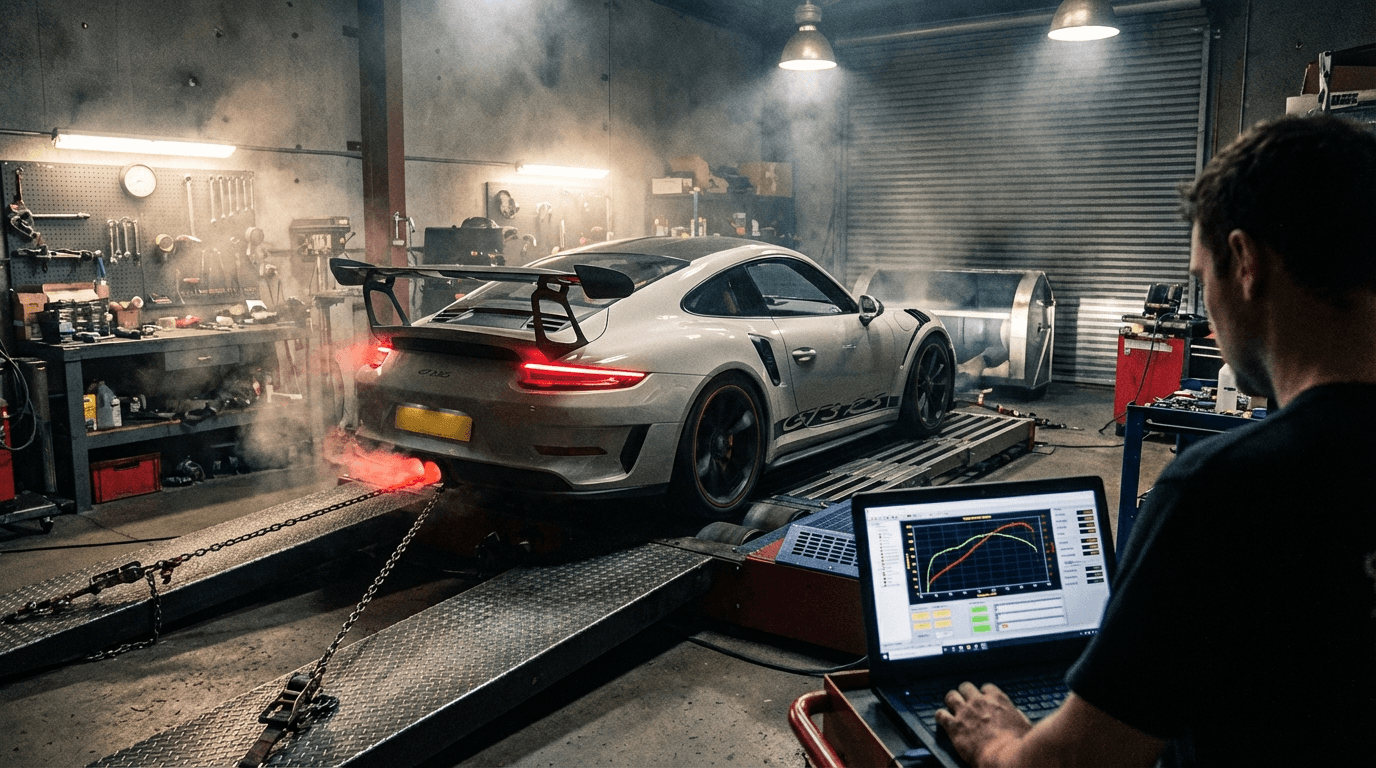
A dyno (dynamometer) session is one of the most exciting and informative experiences in car modification. It is where you find out exactly how much power your car makes, where in the rev range it makes it, and whether your modifications are performing as expected. For tuned cars, it is also where the ECU tune is calibrated for maximum safe performance.
This guide explains how dynos work, what to expect at your first dyno session, how to read dyno graphs, and how to make the most of your time on the rollers.
How a Dyno Works
A dynamometer measures the force (torque) and speed (RPM) output of your engine and calculates power. There are two main types used for car tuning:
Chassis Dyno (Roller Dyno)
The most common type for car tuning. Your car drives onto a set of heavy rollers built into the floor. The driven wheels spin the rollers while the dyno measures the force required to accelerate them.
What it measures: Wheel horsepower (whp) and wheel torque — the actual power reaching the wheels after drivetrain losses (gearbox, differential, axles).
How it works:
- Car is strapped down securely to prevent movement
- Driver accelerates in a specified gear (usually 3rd or 4th)
- The rollers measure the force the wheels exert from low RPM to redline
- The dyno software calculates power and torque curves
Types of chassis dynos:
| Type | How It Works | Pros | Cons |
|---|---|---|---|
| Inertia dyno | Measures how fast the car accelerates heavy rollers | Cheap, fast, simple | Less accurate at high power, affected by wheel slip |
| Eddy current (brake dyno) | Uses electromagnetic resistance to load the engine | More accurate, can simulate real-world loads | More expensive, slower |
| Hub dyno (Dynapack, etc.) | Bolts directly to wheel hubs, no rollers | Most accurate, no tyre slip | Expensive, longer setup time |
Engine Dyno
The engine is removed from the car and bolted to a dyno bench. Measures crankshaft horsepower directly.
What it measures: Crank horsepower (bhp) — raw engine output before any drivetrain losses.
Used for: Engine builders, motorsport teams, development work. Not practical for regular tuning sessions.
Wheel Horsepower vs Crank Horsepower
This distinction confuses many people. The numbers are different because of drivetrain losses.
Crank HP (bhp) — Power at the engine's crankshaft. This is the number manufacturers advertise.
Wheel HP (whp) — Power at the wheels, after losses through the gearbox, differential, and axles. This is what a chassis dyno measures and what actually propels the car.
Drivetrain Loss Estimates
| Drivetrain | Typical Loss |
|---|---|
| Manual FWD | 10-15% |
| Manual RWD | 12-17% |
| Manual AWD | 18-25% |
| Automatic/DCT FWD | 12-18% |
| Automatic/DCT RWD | 15-20% |
| Automatic AWD | 20-30% |
Example: A car rated at 300 bhp (crank) with a manual RWD drivetrain (15% loss) would show approximately 255 whp on a chassis dyno.
Important: Never compare whp numbers across different dyno types or facilities. Different dynos read differently — a Dynapack may read 10-15% differently than an inertia dyno for the same car. Compare your own before-and-after runs on the same dyno.
What Happens at a Dyno Session
Preparation
Before your session:
- Check fluids — Engine oil, coolant, brake fluid (yes, brake fluid — the dyno simulates sustained high-load running)
- Check for leaks — Oil, coolant, boost leaks. A boost leak will show up as disappointing numbers
- Full tank of fuel — Your tuner may need to do many runs. Do not show up with a quarter tank
- Use the fuel you will run — If you daily drive on RON 95, bring it tuned on RON 95. If you use RON 97 or RON 100, bring it tuned on that
- Bring receipts/specs — Your tuner needs to know what modifications are installed
The Session
A typical tuning dyno session:
- Baseline runs — 2-3 pulls to establish current power and torque with your existing tune
- Tuning runs — The tuner adjusts fuel, ignition timing, boost, and other parameters between each run, monitoring for safe operation
- Verification runs — Final pulls to confirm the tune is consistent and safe
- Printout — You receive your dyno graph showing before/after results
Duration: 2-4 hours for a full tune session. A simple "dyno day" check (just measuring power, no tuning) takes 15-30 minutes.
Cost in Malaysia:
- Power check only: RM 100 - RM 300
- Full tune session (flash tune): RM 2,000 - RM 5,000
- Full tune session (standalone ECU): RM 3,000 - RM 8,000
How to Read a Dyno Graph
A dyno graph plots power (hp) and torque (Nm or ft-lbs) against engine RPM. Understanding what the curves tell you is essential for evaluating your tune.
The Torque Curve
Torque is the rotational force your engine produces. On a dyno graph, the torque curve typically:
- Rises from low RPM as the engine fills cylinders more efficiently
- Peaks in the mid-range (where the engine is most efficient)
- Falls off at high RPM as breathing limitations take over
What to look for:
- Flat, wide torque curve — Engine makes strong pulling force across a broad RPM range. Great for street driving.
- Peaky torque curve — Engine makes big numbers in a narrow band. May feel fast at peak RPM but gutless elsewhere.
- Dips or flat spots — Indicates a tuning issue or hardware limitation at that RPM
The Power Curve
Power is torque multiplied by RPM. Because of this relationship:
- Power always peaks after torque peaks (power rises as long as torque times RPM is increasing)
- Power falls when torque drops enough to overcome the RPM increase
What to look for:
- Smooth, continuous rise to peak — Healthy engine, good tune
- Sudden drops or flat spots — Tuning issue, boost issue, or hardware limitation
- Power continuing to rise at redline — The engine wants more RPM (could benefit from higher redline if internals support it)
- Power falling before redline — Normal on most engines (indicates optimal shift point)
Before/After Comparison
The most valuable dyno graph shows your baseline and tuned runs overlaid. This shows exactly where the tune added power and torque across the rev range.
Look for:
- Consistent gains across the rev range (good tune)
- Gains only at the top (tune is sacrificing low-end)
- Losses in some areas with gains in others (tradeoff — may or may not be acceptable)
Common Dyno Questions
Why does my car make less than advertised?
Manufacturers advertise crank horsepower, and they do so under ideal conditions (test cell with controlled temperature and fuel quality). Your chassis dyno measures wheel horsepower (minus drivetrain losses) in real-world conditions. A car rated at 300 bhp showing 250 whp is perfectly normal.
Why did my car make different numbers at two different dynos?
Different dynos measure differently. Inertia dynos, eddy current dynos, and hub dynos all use different methods and correction factors. A "300 whp" reading on one dyno might be "280 whp" or "320 whp" on another. Always compare runs on the same dyno.
How does temperature affect dyno results?
Hotter air is less dense, which means less oxygen per intake stroke, which means less power. A car dyno'd at 2pm on a 38°C Malaysian day will make 5-10% less power than the same car at 8am when it is 28°C. Dyno software applies correction factors (SAE, STD, DIN) to normalise for temperature, but these corrections are not perfect.
For the most consistent results, dyno early in the morning and ensure your intercooler is working efficiently.
Should I dyno in 3rd or 4th gear?
Convention is 3rd or 4th gear because:
- Lower gears have more mechanical advantage and can mask drivetrain losses
- Higher gears are closer to 1:1 ratio, giving more accurate readings
- 3rd/4th provide enough RPM sweep without excessive wheel speed
Your tuner will specify which gear to use for your car.
When to Dyno Your Car
- After a tune — Verify the tune is delivering expected gains
- After significant hardware changes — Confirm modifications are working as expected
- Baseline before modifications — Know where you started
- Troubleshooting — A dyno can reveal issues (boost leak, misfires, fuel delivery problems) that are hard to diagnose otherwise
- Annually — Monitor engine health over time (gradual power loss can indicate developing issues)
For turbo cars, understanding your dyno results in context with your turbo vs NA platform choice helps set realistic expectations.
FAQ
Is wheel horsepower or crank horsepower more useful?
Wheel horsepower is more useful for real-world comparisons because it represents the actual power propelling the car. Crank horsepower is useful for comparing to manufacturer specifications.
How many dyno runs does my car need?
For a power check, 2-3 runs (to confirm consistency). For a tuning session, 10-30+ runs depending on the complexity of the tune and how many parameters need adjustment.
Will the dyno damage my car?
A dyno session puts the same stress on your car as driving at full throttle on the road. If your car cannot handle full-throttle runs, it has underlying issues that the dyno will reveal. Ensure maintenance is up to date before any dyno session.
What if my dyno numbers are disappointing?
First, compare within the context of your dyno (not internet numbers from different dynos). If numbers are genuinely low, the tuner can investigate — common causes include boost leaks, exhaust leaks, fuel quality issues, or hardware not performing as expected.