Car Audio Upgrades: Speakers, Subwoofers, and Amplifiers Explained
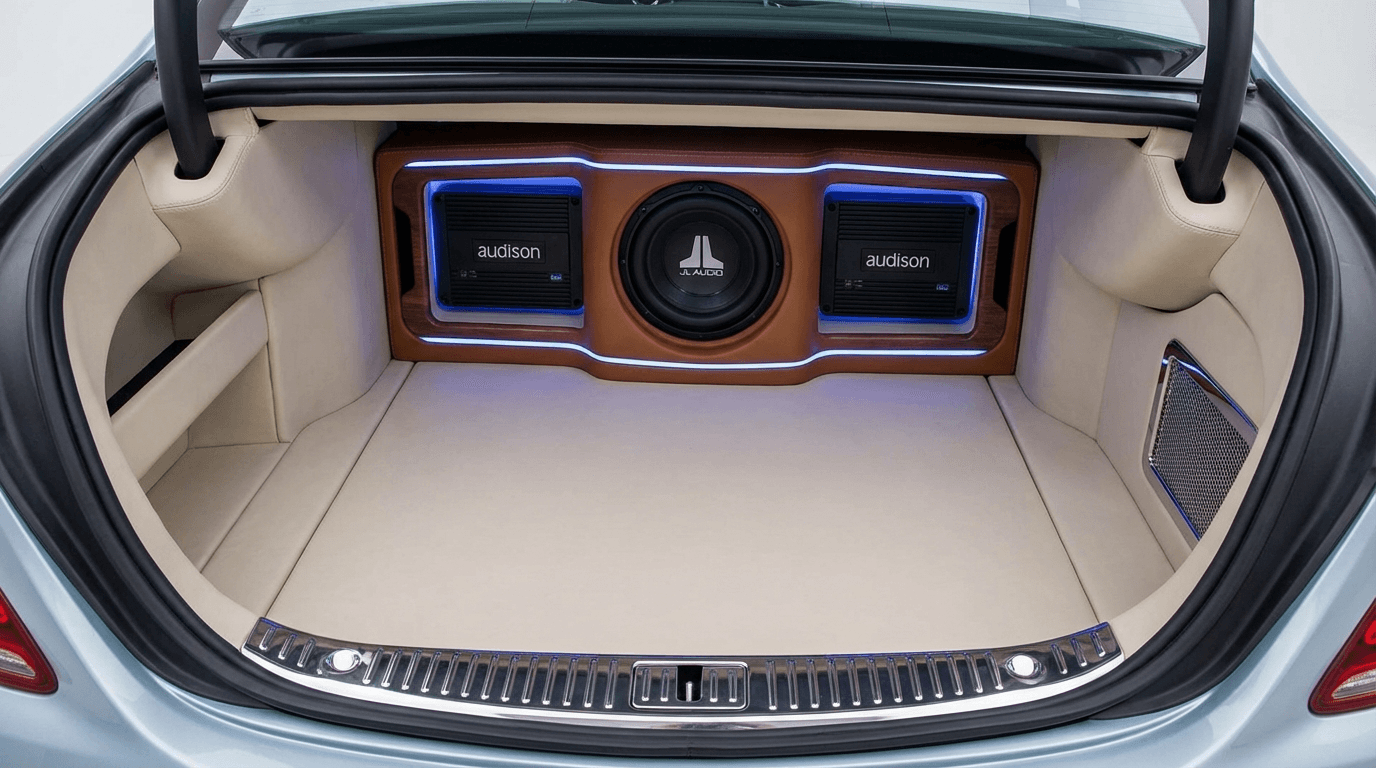
Your car's factory audio system was designed to be "good enough" at the lowest possible cost. The speakers are cheap paper-cone units, the amplification is minimal, and the head unit prioritises features over sound quality. If you care about how your music sounds — and you spend hours driving in Malaysian traffic — upgrading your car audio is one of the most enjoyable modifications you can make.
This guide covers everything from replacing factory speakers to building a complete custom system, with practical advice on getting the best sound for your budget.
How Car Audio Works: The Basics
A car audio system has four main components:
Source (Head Unit) — Where the music comes from. This could be your phone via Bluetooth, a USB drive, streaming apps through Android Auto/Apple CarPlay, or traditional radio. The head unit converts digital audio files into electrical signals.
Processing — The electrical signal from the source needs to be split into frequency ranges (highs, mids, lows) and adjusted. This is handled by the head unit's built-in crossover or a dedicated digital signal processor (DSP).
Amplification — The processed signal needs to be amplified to a level that can drive speakers. This is done by the head unit's built-in amplifier (weak, typically 15-25 watts RMS) or an external amplifier (much more powerful, 50-200+ watts per channel).
Speakers — Convert the amplified electrical signal into sound waves. Different speaker types handle different frequency ranges: tweeters for highs, mid-range drivers for vocals, and subwoofers for bass.
Upgrading Your Speakers
Replacing the factory speakers is the single most impactful audio upgrade for most cars. Factory speakers are the weakest link in the system.
Speaker Types
Coaxial (Full-Range) Speakers — A single speaker unit with a woofer cone and a small tweeter mounted in the centre. Easy to install as a direct replacement for factory speakers. Good for budget upgrades.
- Pros: Simple installation, single unit replaces everything
- Cons: Sound quality limited by tweeter placement (pointing at your feet in door-mounted speakers)
- Price: RM 150 - RM 800 per pair
Component Speakers — Separate woofer, tweeter, and external crossover. The tweeter mounts separately (usually on the A-pillar or dash) aimed at ear level, which dramatically improves soundstage and imaging.
- Pros: Superior sound quality, proper tweeter placement, better crossover
- Cons: More complex installation, requires separate tweeter mounting
- Price: RM 300 - RM 2,500 per pair
Speaker Sizes
Factory speakers come in standard sizes. The most common in Malaysian-market cars:
| Size | Common Location | Notes |
|---|---|---|
| 6.5" (165mm) | Front doors | Most common, widest selection |
| 6x9" (oval) | Rear parcel shelf | Good bass response due to larger cone area |
| 5.25" (130mm) | Front doors, rear doors | Smaller cars (Myvi, Jazz) |
| 4" (100mm) | Dashboard | Older cars, limited options |
| 1" (25mm) | A-pillars, dash corners | Tweeters |
Recommended Speaker Brands
| Brand | Range | Known For | Price Range (pair) |
|---|---|---|---|
| JBL | Budget to mid | Good value, clear sound | RM 150 - RM 800 |
| Focal | Mid to premium | French, excellent detail | RM 500 - RM 3,000 |
| Hertz | Mid to premium | Italian, punchy sound | RM 400 - RM 2,000 |
| Pioneer | Budget to mid | Reliable, widely available | RM 100 - RM 600 |
| Morel | Premium | Israeli, audiophile quality | RM 800 - RM 4,000 |
| Ground Zero | Mid to premium | German, great value | RM 300 - RM 1,500 |
Subwoofers: Adding Bass
A subwoofer handles the low frequencies (20-200Hz) that door speakers simply cannot reproduce. If you listen to any music with bass — hip-hop, EDM, pop, rock — a subwoofer transforms the experience.
Subwoofer Types
Enclosed subwoofer — Pre-built box with the subwoofer already installed. Plug and play. Best for people who want simple bass without custom work.
Free-air subwoofer — Designed to work without an enclosure, typically mounted in the rear parcel shelf. Saves boot space but produces less deep bass.
Component subwoofer — Just the driver (speaker) — you build or buy a separate enclosure. Allows customisation of box type and tuning.
Enclosure Types
The box a subwoofer sits in has a massive effect on its sound:
| Enclosure | Sound Character | Best For |
|---|---|---|
| Sealed (closed) | Tight, accurate, musical bass | SQ (sound quality) builds, all genres |
| Ported (bass reflex) | Louder, more boomy, deeper extension | SPL (loud bass), hip-hop, EDM |
| Bandpass | Very loud at a narrow frequency range | SPL competitions |
| Free-air | Light, space-saving, moderate bass | Boot space priority |
Subwoofer Sizing
| Size | Bass Character | Power Needed | Boot Space |
|---|---|---|---|
| 8" | Tight, quick, subtle | 100-200W RMS | Minimal |
| 10" | Good balance of punch and depth | 200-400W RMS | Moderate |
| 12" | Deep, powerful, most popular size | 300-600W RMS | Moderate to large |
| 15" | Thunderous, competition-level | 500-1,500W RMS | Large |
For most people, a single 10" or 12" subwoofer in a sealed or ported box is the sweet spot.
Amplifiers: Powering Your System
An amplifier takes the low-power signal from your head unit and amplifies it to drive your speakers and subwoofer with authority. Even good speakers sound mediocre on a weak factory head unit amplifier.
Amplifier Classes
| Class | Efficiency | Heat | Best For |
|---|---|---|---|
| Class A/B | Moderate (50-65%) | Moderate | Full-range speakers, SQ builds |
| Class D | High (80-90%) | Low | Subwoofers, compact installs |
| Class D (full-range) | High | Low | Modern all-in-one solution |
How Many Channels?
| Configuration | Channels | Use Case |
|---|---|---|
| 2-channel | 2 | Front speakers only, or bridged to 1 channel for a sub |
| 4-channel | 4 | Front + rear speakers, or front speakers + bridged sub |
| 5-channel | 5 | Front speakers + rear speakers + subwoofer (all-in-one) |
| Mono (1-channel) | 1 | Dedicated subwoofer amp |
For most builds, a 4-channel amplifier running front speakers on 2 channels and a subwoofer bridged on the other 2 is the most versatile setup.
Matching Amplifier to Speakers
The amplifier's RMS power per channel should match or slightly exceed the speaker's RMS power handling. Never match based on "peak" or "max" power — those numbers are meaningless marketing.
- Speaker rated at 60W RMS → amplifier should provide 60-80W RMS per channel
- Subwoofer rated at 300W RMS → amplifier should provide 300-400W RMS
Sound Deadening
This is the most overlooked aspect of car audio. Your car's thin metal door panels vibrate and rattle, cancelling out bass and muddying the sound. Sound deadening material applied to the door panels dramatically improves speaker performance.
What Sound Deadening Does
- Reduces panel vibration — Stops the door skin from resonating with the speaker
- Creates a sealed enclosure — Turns the door into a proper speaker enclosure
- Reduces road noise — Less external noise means you hear more detail at lower volumes
- Improves bass response — Less energy lost to panel flex
Materials
| Material | Type | Application | Price |
|---|---|---|---|
| Dynamat / StP | Butyl rubber mat | Door panels, floor, boot | RM 30 - RM 80 per sheet |
| Closed-cell foam | Barrier/absorber | Behind door cards, roof | RM 20 - RM 50 per sheet |
| Mass-loaded vinyl (MLV) | Sound barrier | Floor, firewall | RM 50 - RM 100 per sqm |
For most people, applying butyl rubber deadening to the front door outer skins and inner skins is the most impactful treatment. Budget RM 200-500 for a proper front door treatment.
The Upgrade Path: Best Order for Your Budget
RM 500 - RM 1,000: Entry Level
- Replace front speakers with quality coaxials (RM 300-500)
- Sound deaden front doors (RM 200-400)
- Result: Dramatically better clarity and detail than stock
RM 1,500 - RM 3,000: Enthusiast
- Front component speakers (RM 500-1,200)
- 4-channel amplifier (RM 400-800)
- Sound deadening front doors (RM 200-400)
- 10" or 12" subwoofer + enclosure (RM 400-800)
- Result: Complete, balanced system with real bass
RM 3,000 - RM 6,000: Premium
- Premium front components (RM 1,000-2,500)
- Quality 5-channel amplifier (RM 800-2,000)
- Dedicated mono sub amp (RM 400-1,000)
- 12" subwoofer in custom enclosure (RM 600-1,500)
- Full sound deadening (RM 500-1,000)
- DSP for tuning (RM 500-1,500)
- Result: Audiophile-quality system
Head Units and DSPs
Aftermarket Head Units
If your car has a standard DIN-sized head unit (increasingly rare in modern cars), replacing it with an aftermarket unit from Pioneer, Kenwood, or Alpine gives you better processing, more power, and features like Android Auto/Apple CarPlay.
Digital Signal Processors (DSP)
For cars with integrated factory head units that cannot be replaced (most modern cars), a DSP is the solution. It sits between the factory head unit and your aftermarket amplifier, providing:
- Time alignment (corrects for speakers at different distances from your ears)
- Equalisation (31-band EQ for precise tuning)
- Crossover control (properly split frequencies between speakers)
- Level matching (balance output between channels)
A DSP is the single biggest upgrade for sound quality in a modern car with an integrated head unit. Popular units include the Helix DSP, Audison Bit, and miniDSP.
If you are also upgrading your car's lighting, consider doing both at the same time to minimise the number of workshop visits and save on installation labour.
FAQ
Will upgrading speakers alone make a big difference?
Yes, replacing factory speakers with quality aftermarket units is the single most impactful upgrade, especially paired with basic sound deadening. Even without an amplifier, you will notice significantly better clarity and detail.
Do I need an amplifier?
For speakers, an amplifier is highly recommended but not strictly necessary — quality speakers will sound better than factory even on head unit power. For a subwoofer, an amplifier is mandatory.
Will a subwoofer drain my battery?
A properly installed system with a quality amplifier draws minimal power at normal listening levels. Only competition-level systems with 1,000+ watts need battery or alternator upgrades.
How much boot space does a subwoofer take?
A compact 10" sealed enclosure is about the size of a small backpack. A 12" ported box is larger — about the size of a carry-on suitcase. Slim under-seat subwoofers are available for minimal space impact.
Can I install car audio myself?
Speaker swaps and head unit replacements are doable with basic tools and patience. Amplifier and subwoofer installation involves running power cables from the battery and signal cables through the car — this is more involved and many people prefer professional installation (RM 200-500 for basic amp + sub install).